Versión en español aquí.
English Edition
Raw Science is expanding into English. Rather than wait for a finished archive, I’m publishing as the work is translated and refined: the first deep dive live now, and more weekly through the summer. The full launch, including the Pro membership tier, is planned for summer 2026.
Table of Content
Copper and the energy transition
Every time a politician announces a new wind farm, there’s a statistic that usually goes unmentioned: an offshore wind system requires between 8 and 15 tonnes of copper per megawatt of installed capacity, depending on the distance to shore and the electrical infrastructure. A natural gas plant requires around one tonne. This difference reflects the gap between the discourse and the physics of the energy transition.
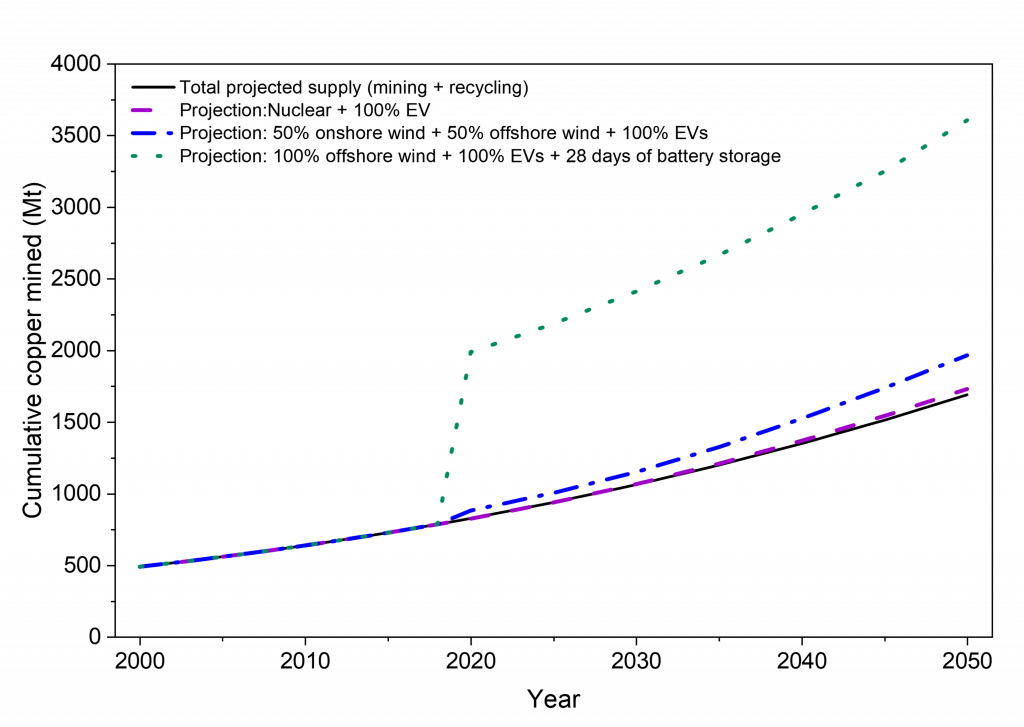
To meet the Net Zero scenario by 2050, more copper may have to be produced over the next 25 years than was extracted between 1900 and 2021.1 Of course, the magnitude of the challenge depends on the type of transition chosen. An analysis by Cathles, L. M., et al.2 compares cumulative copper demand with a BaUDefiniciónBusiness-as-Usual (BaU) is a baseline scenario describing the future evolution of a system without relevant structural changes in policies, technologies, or behaviour, implying continuity of historical patterns (production, consumption, investment supply. The result, shown in Figure 1, shows that a nuclear-based system with moderate electrification barely differs from BaU (~+2–3% in 2050), while a wind mix with 100% electric vehicles (EVs) adds ~275 Mt. A scenario consisting of 100% offshore wind with 100% EVs and 28 days of storage would drive the copper demand up to ~3,600 Mt: more than double the projected supply (accounted at approx. 1,700 Mt). Moreover, the increase would not be gradual: it appears as an initial shock, since storage must be massively deployed before the system can operate.
This article addresses a frequent framing error in the public debate, which is conflating copper reserves with copper supply. While reserves are abundant, the annual deliverable copper supply is not. The focus is on the variables that actually govern flow, i.e, ore grade, mine lead times, capital intensity, processing concentration, and recycling rates, and on how those variables align (or fail to align) with the timelines of current decarbonisation policies.
Why copper is irreplaceable
Before talking about copper scarcity and copper as critical metal, it is worth clarifying that copper is not simply a good conductor, but is the standard against which all other materials are measured in terms of conductivity. Indeed, the International Annealed Copper Standard (IACS) sets the conductivity of annealed copper (58×10⁶ S/m at 20 °C) as 100%, and any other material is evaluated relative to that reference (see Table 1).3 Silver, the best known metallic conductor, only exceeds copper conductivity by 5–8%, but that marginal advantage comes at its disproportionate cost, since it is several tens of times more expensive per kilogram than copper and it carries its own limitations in terms of availability, mining, and geopolitical concentration. Aluminum, the only realistic substitute at an industrial scale, reaches only 61% IACS, which means an aluminum conductor needs a cross-section roughly 40% larger to carry the same current as copper.3
| Metal | Electrical conductivity at 20–25°C (MS/m) | Electrical conductivity relative to copper | Thermal conductivity (W/m·K) | Electrical resistivity at 20 °C (Ω·m) |
|---|---|---|---|---|
| Copper | 58.0–59.6 | 100% | ~385–401 | 1.7×10⁻⁸ |
| Aluminum | 37.7 (high-purity annealed aluminum) | ~63% of Cu | ~205–237 | 2.82×10⁻⁸ |
| Silver | 63.0 | ~106% of Cu | ~406–429 | 1.59×10⁻⁸ |
| Gold | 44.2 | ~74% of Cu | ~314–315 | 2.44×10⁻⁸ |
However, the electrical conductivity of copper is not the only reason. Copper has a property that aluminum does not have, and which is critical in electrical connections: its oxides are soft and electrically conductive. Aluminum oxide (Al₂O₃), by contrast, is hard, tough, and electrically insulating. This property has enormous economic and regulatory consequences: for instance, data from the US Consumer Product Safety Commission show that US homes with pre-1972 aluminum wiring were 55 times more likely to present fire-risk conditions at outlets than homes with copper wiring.5 As a consecuence, since 1987, the US National Electrical Code has banned aluminum in residential branch circuits. That single regulatory decision fixes, almost irreversibly, an enormous fraction of copper demand for construction.
It is worth mentioning that aluminum is indeed substituting for copper at an industrial scale, in particular in power transmission lines, transformer windings, electric vehicle wiring harnesses, battery busbars, and EV electronics, and there is active research into new copper substitutes, as I analyse woth more detail in this article. Nevertheless, despite all these developments, approximately 70% of copper applications remain practically locked in, due to a combination of safety requirements, efficiency standards, and the lack of viable alternatives at competitive prices.6
And here is the point I find the public debate often overlooks: when it is claimed that “the market will find substitutes,” what is actually being talked about is the 30% where substitution is viable. The remaining 70% is, to a large extent, copper or nothing.
Copper demand: How much copper is needed to electrify the world?
Global refined copper consumption reached approximately 27.4 million tonnes (Mt) in 2024, and China alone accounts for around 58% of world demand.7 And 75% of global copper is used mainly in electrical applications such as distribution networks, wiring, electronics, and electrical equipment,8 with wire products representing approx 63% of the total demand.
But what happens when we electrify everything?
Vehicles
A car with an internal combustion engine contains approximately 23 kg of copper. A hybrid vehicleDefiniciónThe Hybrid Electric Vehicle (HEV) combines an internal combustion engine with one or more electric motors, powered by a small battery that does not plug in externally, about 40 kg. A plug-in hybridDefiniciónThe Plug-in Hybrid Electric Vehicle (PHEV) is a hybrid vehicle with a higher-capacity battery that can be charged from the electrical grid. around 60 kg. A battery electric vehicleDefiniciónThe Battery Electric Vehicle (BEV) is powered exclusively by one or more electric motors, fed by a rechargeable battery. It has no combustion engine or fuel tank. sits in the range of 60 to 83 kg, with recent estimates from Benchmark Minerals Intelligence placing the current average value around 70 kg, with a downward trend toward ~45 kg by 2030 thanks to redesigns and busbar substitution.9 The difference is amplified in heavy transport: an electric bus requires between 224 and 369 kg, and an electric truck can exceed 300 kg.10
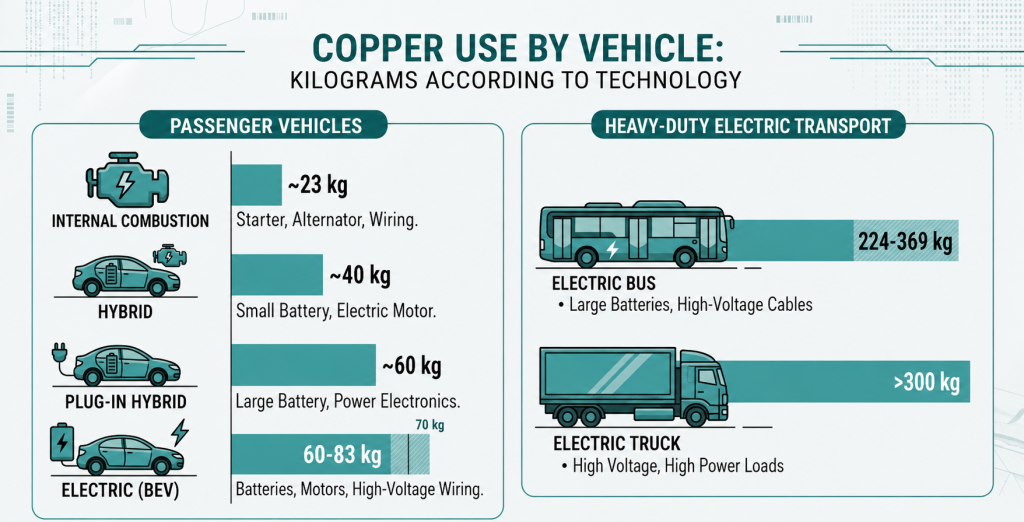
Although technological advances tend to reduce the copper needed per unit, the dominant effect that makes copper demand a concern is the production volume. Indeed, Benchmark projects a 177% increase in copper demand associated with electric vehicles and batteries by 2030, reaching around 2.5 Mt annually for electric vehicles alone.9 To put it in context: that figure is approximately equivalent to the entire annual production of Perú.
Renewables
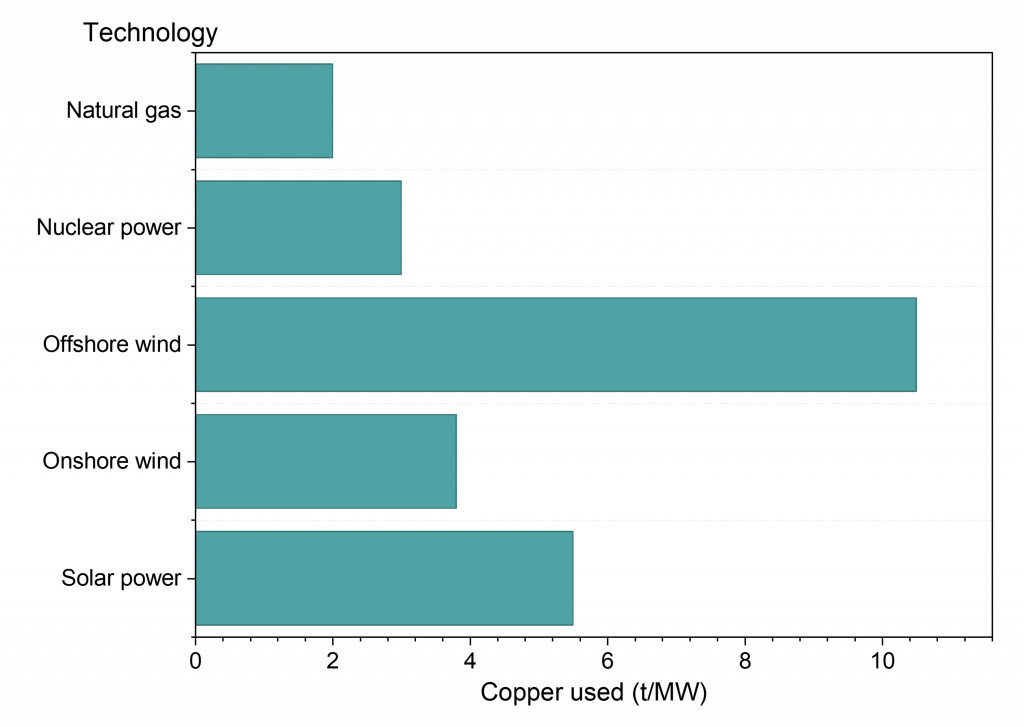
An onshore wind turbine requires approximately 3.5 tonnes of copper per MW installed. In offshore wind, the demand rises to 8–10.5 t/MW, with individual 3.6 MW turbines containing around 29 tonnes of copper each.11 It is important to understand where that copper is needed: about 58% corresponds to wiring and the electrical connections, not the turbine itself. The demand for copper for utility-scale solar PV is around 2.5 t/MW, although including the balance of system, it can reach up to ~5.5 t/MW.12 Against this, a gas plant accounts for around ~2 t/MW, and a nuclear power plant is in a similar range, around 2–3 t/MW.
Electricity grid
The global electricity grid currently spans 70–80 million kilometres, with around 150 Mt of copper and 210 Mt of aluminum installed. However, that is only the starting point: the International Energy Agency projects that this infrastructure will need to almost double to ~150-170 million kilometres by 2050, at a cost of around $21 trillion.13 Consider that, even though aluminum is widely used in the grid, a single 400/100 kV transformer can still contain up to 50 tonnes of copper.14 As a result, copper demand for electricity grids alone may grow from 4.1 Mt in 2023 to 6.2 Mt in 2035 according to IEA14 and Sprott estimations.15
So, how much copper are we going to need?
The answer depends on the source, the model, and, above all, the underlying assumptions about electrification speed, technology mix, and policy ambition. This is one of the points where the public narrative most distorts the data, and Table 2 shows the most cited sources.
| Source | Projection (Mt of copper) | Year |
|---|---|---|
| IEA GCMO 2025 (STEPS) | 33 Mt | 2035 16 |
| IEA GCMO 2025 (STEPS) | 37 Mt | 2050 16 |
| S&P Global, 2022 (NZE) | ~50 Mt | 2035 1 |
| Wood Mackenzie, 2025 | 42.7 Mt | 2035 17 |
| S&P Global, January 2026 | 42 Mt | 2040 18 |
| BHP, 2024 | >50 Mt | 2050 19 |
I want to highlight that the ~50 Mt projection for 2035 from S&P Global (Net Zero scenario, NZE, 2022) is approximately 50% higher than the STEPS (Stated Policies Scenario) estimated from the International Energy Agency for the same year (2023). And this is not a minor difference, yet both projections often appear in the media as if they were comparable. The key lies in the assumptions: the NZE implies an accelerated deployment of electrification and decarbonisation, while STEPS reflects currently committed policies.
That is why, when someone claims that “copper demand is going to double“, the relevant question is not whether it is true, but under which scenario. The differences between projections reflect different futures, but there is something that does not change between them: whichever curve you choose, in all cases, the additional amount of copper needed is enormous. The discrepancy is in how much the problem grows, not in whether it exists.
Copper supply: geological, temporal, and financial limits
Copper is not going to run out: there is plenty of copper available.
The identified global reserves of copper are 980 Mt, the identified resources 2,100 Mt, and the undiscovered resources are estimated at 3,500 Mt, for a total of around 5,600 Mt according to the USGS.20
At the current rate, that would last for centuries. The problem, I insist, is not about resources; it is more likely operational: how much copper can be extracted per year, of what quality, at what cost, and on what timescale.
Collapse of copper ore grade
Chile, the world’s largest copper producer, has seen its [definit texto: “The ore grade refers to the concentration of an economically valuable metal or mineral within a given rock mass. It is generally expressed in two ways: (i) as a percentage (%) for common metals (such as copper, lead, or zinc) and (ii) in grams per tonne (g/t) for precious metals (such as gold or silver). This measure is crucial in mining because it determines the economic viability of a project: a higher grade means more valuable ore can be obtained from the same amount of rock processed.”]ore grade[/definir] falling from approximately 1.27% copper in 2000 to 0.65% in 2024: a 49% drop in 24 years.21 At Escondida, the world’s largest mine, the grade has fallen from ~3% in the 1990s to around 1% in 2024.22 And BHP is investing between $4.4 and $5.9 billion in a new concentration plant to maintain the current processing capacity, rather than expanding it.23 Further, this is not just a local tendency; indeed, the average global copper ore grades have fallen by 40% since 1991.16
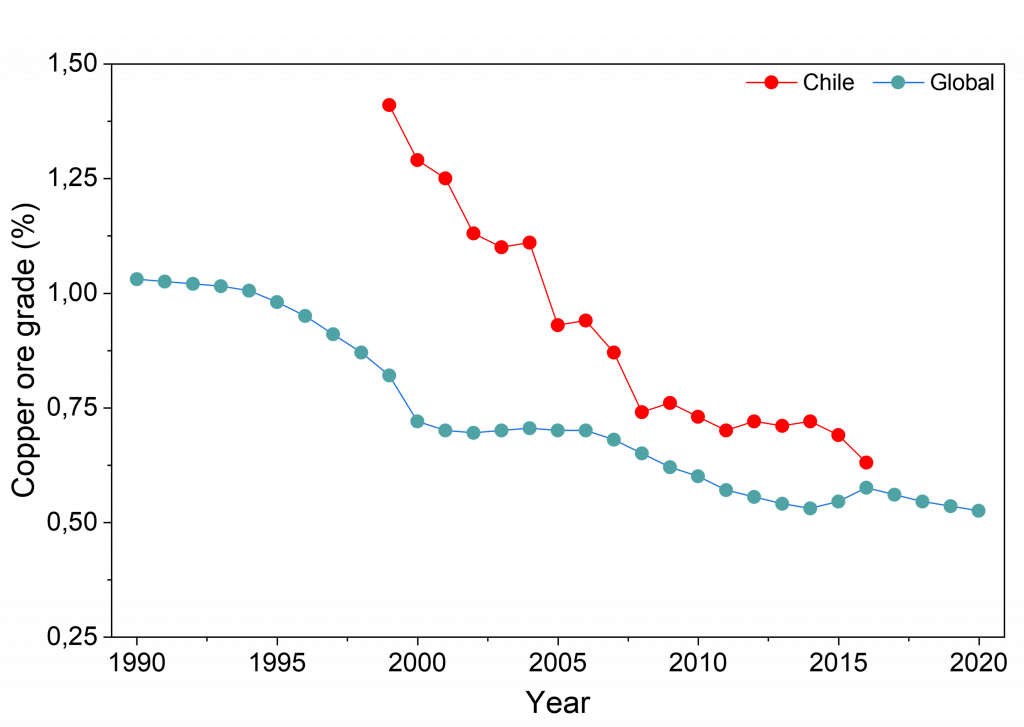
Worth noting is that the relationship between ore grade and resource consumption is inverse: the lower the grade, the greater the energy, water, and volume of material that must be moved per tonne of copper. At a grade of 0.5%, each tonne of copper requires moving ~200 tonnes of rock. At 0.25%, 400 tonnes. The study by Calvo et al.24 shows a specific case: Chilean mines experienced a 25–29% drop in ore grade between 2003 and 2013, and over the same period, the energy consumption rose by 46% while the production grew by only 30%.
Increase in the development times of copper mines
Development times are maybe one of the bigger bottlenecks in my view. According to the S&P Global data, the average time from the discovery of a deposit to the start of production has grown from 12.7 years for mines started in 2005–2009 to 17.9 years for those started in 2020–2023.25 In the United States, that timeframe averages 29 years, with permitting processes alone potentially adding between 7 and 10 years. That said:
If a copper mine is not already under construction today, it is not going to contribute significantly to the supply in 2030.
And there is no margin for “accelerations” without deep regulatory reforms that nobody is seriously debating.
It is also worth noting that between 2019 and 2023, S&P Global recorded just 4 major copper mine discoveries, with a total of 4.2 Mt of contained copper. By comparison, during the 1990s, up to 18 major discoveries per year were recorded.26
Investment gap in copper supply
And as if that weren’t enough, the combination of the temporal inertia of mines, the decline in ore grade, and the lack of new discoveries shifts the problem: it stops being purely geological and becomes, inevitably, financial. In other words, investment is not keeping pace with what the transition demands.
Global CAPEX in copper development reached its peak in 2013, at $26.1 billion. Since then, it has fallen significantly: in 2022, it stood at around $14.4 billion, approximately half.26 And yet, the needs are heading in the opposite direction. BHP estimates that approximately $250 billion in mining investment will be needed between now and 2030 to sustain the transition.19 McKinsey & Company, more conservatively, places the figure at around $200 billion by 2035.
It is not just a question of how much is invested, but of how much it costs to produce each new tonne: the weighted average capital intensity of 26 upcoming projects reaches $22,359 per tonne of annual capacity,27 well above historical levels. The reason is, again, geological: new projects are deeper, with lower ore grade, and have more complex metallurgies. Each additional tonne of copper is more difficult and more expensive than the previous one.
Copper processing: the invisible geopolitics
There is a dimension of the copper market that receives much less attention than mining supply and that, nevertheless, may be more decisive in the short term: the Chinese concentration in copper processing. Copper is not used as it comes out of the mine. It must first be concentrated, smelted, and refined. And it is at that stage that a critical part of the system is concentrated.
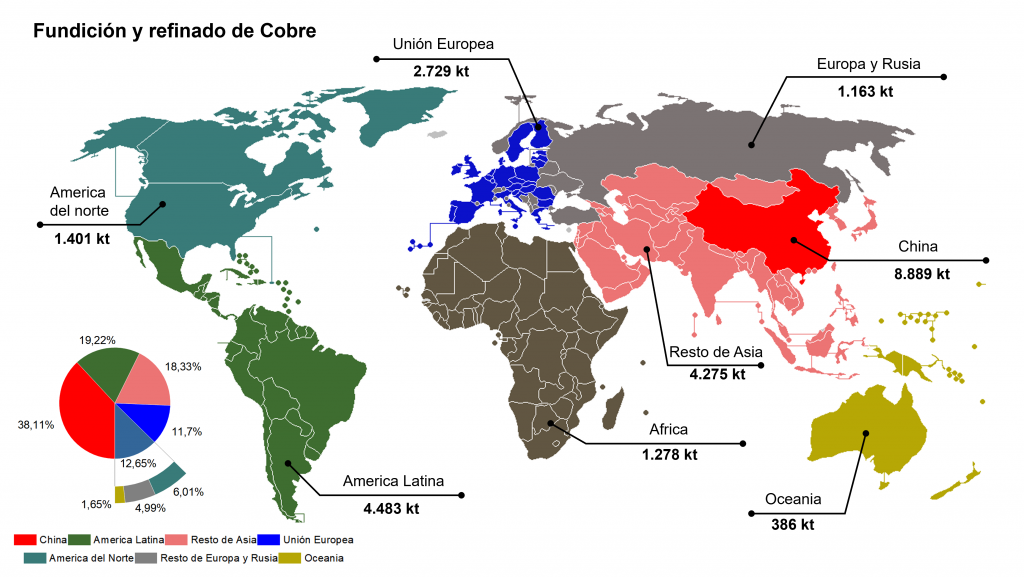
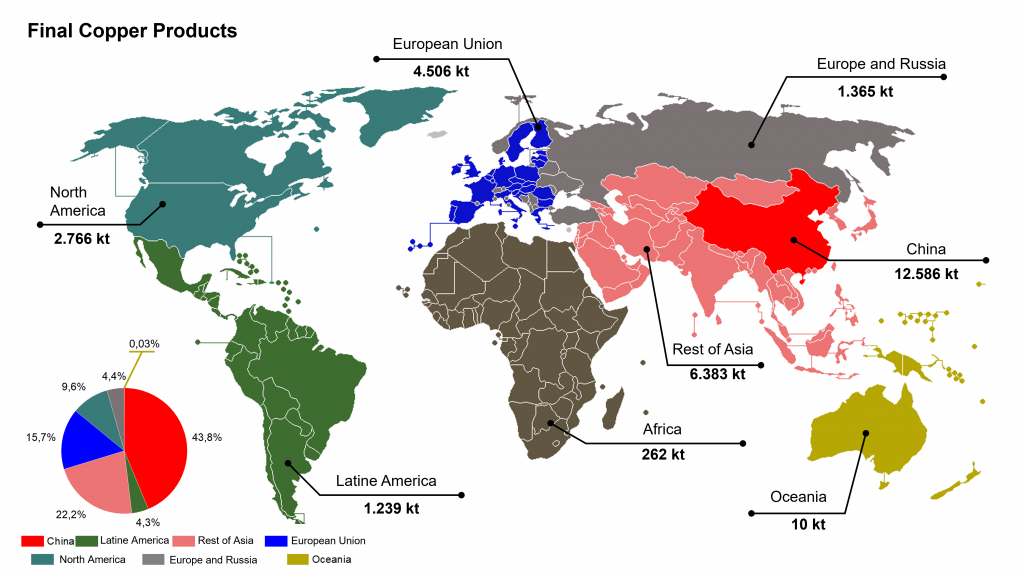
In 2024, China processed approximately 45% of the world’s refined copper, controls around 40% of global smelting capacity, and absorbs about 66% of world concentrate imports.28 Four of the five largest smelters in the world are, in fact, in mainland China. And this trend is not recent: since 2000, China has accounted for approximately 75% of global smelting capacity growth.29 Outside China, that capacity has barely changed in two decades.
This imbalance is already visible in the most direct indicator of the system: the treatment and refining charges (TC/RCs). TC/RCs are what smelters charge to process the concentrate. When there is enough ore, smelters have bargaining power and the charges are positive; when concentrate is scarce, the opposite happens. And that is exactly what is happening: the benchmark has fallen from ~$80/t in 2024 to $21.25/t in 2025, while the spot market has turned negative for the first time, reaching -$60/t in November 2025.30 For 2026, the market points to ~$0/t.
In other words: copper smelters are paying not to run out of raw material.
The cause is a structural mismatch: smelting capacity, driven largely by China, has grown much faster than mining production. In fact, there are at least 3.4 Mt/year additional smelters under construction against a concentrate supply that is barely advancing31 and many smelters operate with negative margins, sustained by by-product revenues (sulphuric acid, gold, silver), state subsidies or cross-subsidies within large industrial groups.
And undoing it is not trivial either. According to Wood Mackenzie, replicating that capacity outside China would require between $85 billion and $126 billion: in practice, redoing the geopolitics of processing is not a market issue, but one of decades of coordinated investment.
This has an enormous geopolitical implication that the debate on “supply chain resilience” usually overlooks: even if the West manages to diversify copper extraction away from countries under Chinese influence (something that is far from settled…), the concentrate still has to go to Chinese smelters because there is not enough alternative capacity.
Independence of copper supply is not decided in the mines. It is decided in a handful of metallurgical plants.
Copper recycling: keeps at 33%
One of the most repeated arguments in defence of the viability of the transition is that copper is perfectly recyclable. And that is true: copper recycling retains 100% of the metal’s properties after multiple cycles, requires only 10–20% of the energy of primary copper, and reduces emissions by up to 85%.32
But that is not what is concerning. The question is whether copper recycling can be scaled up sufficiently and quickly enough. So far, the answer appears to be no, at least under current global conditions.
Let´s see why.
Recycling is increseasing, but the copper recycling share is not growing. The share of secondary copper in total supply is not increasing, but, ironically, decreasing: from 37% in 2015 to 33% in 2023.7 In other words, even with more recycling in absolute terms, the system depends increasingly on primary mining. The reason is simple: demand grows faster than scrap supply.
The temporal limit (again). The average useful life of copper products is around 35 years. The copper installed today in buildings, networks, or vehicles will not return to the system as scrap until well into the 2050s. This introduces a critical lag: recycling cannot respond to the 2025–2035 window because the copper we would need to recover is still in use. Even in emerging sectors, such as electric vehicles, growth is misleading: EV scrap could multiply by more than 35 between 2030 and 2050, but starts from a virtually low base.33
The quantitative limit. The IEA projects that secondary copper could reach 35% of total supply by 2050 under ambitious policy scenarios.33 S&P Global, in its January 2026 report, projects that recycling can roughly double from 4 to 10 Mt by 2040.18 Even in those scenarios, recycling provides about a third of projected demand. The other two-thirds have to come from primary mining. In fact, the World Bank estimates that even with 100% end-of-life recycling, primary demand would only be reduced by 26% by 2050.
The industrial limit. On top of all this, there is another, less visible limitation: the infrastructure. Having scrap available is not enough if there are no local facilities to process it. The United States lacks secondary copper smelters, which forces it to export much of its scrap to China, Malaysia, or Europe so that the material can be recovered.34 It is not an isolated case: only 3 of the 22 countries audited by the IEA have complete regulatory frameworks for recycling. Europe presents a more developed picture, with closed cycles and active regulation, even though a significant east-west gap persists: while Germany, Belgium, or Sweden maintain robust systems, eastern countries have considerably weaker infrastructures; and scrap exports to countries with looser environmental regulation remain an unresolved structural problem.35
Recycling is indeed necessary, but it is not sufficient. And the difference between necessary and sufficient is exactly where the public narrative of the circular economy can become misleading.
Is copper… green?
I understand that this is a trigger question, but at least four things rarely appear together in the public debate on copper, and that nevertheless are inseparable from an honest analysis: (i) the environmental cost of copper, (ii) the need for water, (iii) social conflicts, and (iv) geological inflation.
The environmental cost of “green” copper
Global emissions from copper production accounted for approximately 112 Mt CO₂e: we are talking about 0.2% of global anthropogenic emissions.36 The 87% of the total copper production emissions were generated by the only production of refined copper. Further, under a doubling-of-demand scenario by 2050, emissions associated with the copper cycle could reach 2.7% of the total emissions budget compatible with the much-debated 1.5°C limit.37 Even with maximum industrial mitigation, the sector would still be 35% above its proportional emissions target.
It even sounds ironic: producing the metal that enables decarbonisation generates rising emissions just when we need them to fall.
Water stress
I think Chile is one of the best examples for discussing the copper cycle’s dependence on water. Copper mining in Chile consumes approximately 500 million m³ of water per year in a desert that has been in a megadrought for more than 14 years.38 As in any industry, solutions are always sought, and in this case, it is the use of desalinated water: 40% of mining water in Chile already comes from seawater desalination, and is projected to reach 67% by 2034.38
But desalination is not a free hedge. Pumping seawater up to 3,100 m altitude across ~170 km of pipeline can cost up to 10 times more per cubic metre than groundwater, embedding a permanent and energy-linked opex layer into every tonne of copper produced. The downside risk is already documented in producer accounts: Anglo American’s Los Bronces has cut production guidance from 505,000 t (2023) to 380,000–410,000 t (2025): a ~25% decline over two years explicitly attributed to water scarcity in the Maipo and Aconcagua basins, with the mine committed to eliminating freshwater use by 2030. BHP’s Cerro Colorado was placed into care and maintenance in 2023 after Chile’s Supreme Court ruled in favour of indigenous communities whose wetlands had been depleted by mine pumping; BHP is now evaluating a $1.3 billion restart by 2028.39
Community conflicts
We all know that geology is not isolated from society. 47% of the 300 largest undeveloped copper deposits in the world are on or near indigenous peoples’ lands.40 Las Bambas (Peru) has accumulated 661 days of blockades since 2016, with losses estimated in several million dollars per day.41 Cobre Panamá (First Quantum), which produced 1.5% of global supply, was declared unconstitutional by Panama’s Supreme Court in November 2023 after massive protests, and has been in “preservation and safe maintenance” since then.42 Resolution Copper in Arizona faces significant opposition for its impact on sacred lands. In parallel, organisations such as Amnesty International have documented forced evictions, sexual assaults, and abuses in the industrial expansion of the DRC’s copper-cobalt belt.43 And these are just a few examples.
Geological inflation
I emphasise here once again the fall in copper ore grade because it is the hardest to see, and its implications are not as obvious. As ore grade decreases, each additional tonne of copper requires more energy, more water, more material removed, more waste, and more capital. It is not an externality that can be eliminated: it is thermodynamics. Technology can partially mitigate this effect, but not reverse it. Any supply projection that does not incorporate this factor is making a conceptual error.
Strategic Implications
The chokepoint: mines or smelters?
In my view, the most useful way to read the TC/RC collapse documented above is as a price signal that the binding constraint has structurally migrated. From 2010 through roughly 2022, the concentrate availability was approximately matched to the smelting capacity, and treatment charges sat in the $80–120/t range that lets smelters cover costs and earn a small margin. In 2025, the benchmark fell to $21.25/t. By November 2025, the spot market turned negative at -$60/t. For 2026, the market points to ~$0/t. This means that, basically, Chinese smelters are willing to pay to receive raw material because letting the capacity sit idle costs them more than absorbing negative refining margins.
This matters because almost every public policy response to copper supply-chain risk, ibcluding the EU Critical Raw Materials Act, the US 2022 IRA mining provisions, and the AUKUS critical minerals pact, frames the problem as one of extraction diversification, with the implicit theory that if Western mines, or friendly-jurisdiction mines in Canada, Australia, Chile, Peru, replace Chinese-influenced extraction, the supply chain becomes resilient. The TC/RC data suggest to me that the theory isn’t entirely accurate. Even if every new copper mine over the next decade is in a friendly jurisdiction, the concentrate still has to go somewhere to be smelted and refined, and the somewhere is almost entirely China. I remember the reader: four of the five largest smelters in the world are in mainland China. China has absorbed roughly 75% of all growth in smelting capacity this century. Wood Mackenzie’s projection that between $85 billion and $126 billion would be needed to replicate that capacity outside of China seems more like a matter of capital coordination… the kind of matter that Western industrial policy has struggled to solve so far this century.
And this would reframe several theses. It seems to me that mining operations that rely exclusively on copper from friendly jurisdictions are less secure from a geopolitical perspective than they appear, since concentrate procurement continues to be mediated by Chinese midstream companies, regardless of who owns the ore. In the short run, a negative TC/RC environment is corrosive for unsubsidized smelters, and structurally, it underlines that non‑Chinese smelting and refining capacity is now the weakest link in the copper supply chain. Against that backdrop, new Western metallurgical projects such as Aurubis’ Richmond secondary smelter in Georgia, one of the only major additions to primary metal output outside China in decades, may be more geopolitically consequential to track than the next mine announcement.
From a policy point of view, the 40% domestic processing target by 2030 of the CRMA correctly identifies midstream smelting and refining capacity as the binding constraint, but the real question is whether Europe is willing to tolerate subsidized or negative smelting margins for long enough to build durable capacity. The Chilean situation is a good example (IEA Report): despite the dominance of Codelco in the extraction and longstanding ambitions to expand domestic value‑added, the refined‑copper output from Chile has declined while concentrate exports have grown, indicating that even major resource‑holding states may rationally prefer to export concentrates rather than absorb the energy and carbon burden of refining at home. Back to the Aurubis example, Europe’s largest copper producer now operates in an environment where energy costs are ‘far too high by international standards’ and where management openly warns that energy prices are one of the biggest threats to German heavy industry: a context in which domestic smelting capacity will not be built or maintained at scale without predictable policy support… even though it is precisely this capacity that CRMA‑style strategies seek to secure.
What would change this view: A genuine Western smelting build‑out. If, over the next five years, Aurubis Richmond ramps to meaningful utilization, a second EU‑backed primary smelter reaches final investment decision, and a US primary smelter restarts on a durable, policy‑underwritten footing, then the non‑Chinese midstream gap would start to close in a way that justifies marking down the geopolitical risk premium on “friendly” copper. But that build‑out would also need to clear an energy test: these plants must be able to lock in long‑term power on terms that do not leave them permanently stranded above Chinese smelters on the cost curve. Without both new smelter capacity and credible solutions to Europe’s structural energy‑price disadvantage, the smelting chokepoint only deepens, regardless of where the mines are, and 2030 production targets remain a distraction.
Substitution of copper, how far?
Substitution is the other lever that ultimately disciplines copper scarcity: if smelting bottlenecks and high prices persist, some demand will migrate to alternative materials and architectures. How far that process can go, and on what time frame, is a separate question that I address in this article.
How to cite this article
Caniglia, G. (2026). “Copper and the energy transition: the potential physical bottleneck.” Raw Science. Available at raw-science.org.
References
- S&P Global (2022). The Future of Copper: Will the looming supply gap short-circuit the energy transition? S&P Global Commodity Insights.
- L. M. Cathles, et al. (2025) Copper: Mining, Development, and Electrification. SEG Discovery; (141): 13–20. doi:10.5382/SEGnews.2025-141.fea-01
- De Keulenaer, H. Leonardo Energy / European Copper Institute. Copper sets the standard for conductivity (IACS reference).
- Halliday, D., Resnick, R., Walker, J.; (2018) Fundamentals of Physics, Extended, 11th ed.
- Bunten, E.D. et al., US Consumer Product Safety Commission (1974). Hazard Assessment of Aluminum Electrical Wiring in Residential Use.
- Wang, T et al. (2021). “Copper Recycling Flow Model for the United States Economy.” Environmental Science & Technology, 55, 8, 5485–5495. doi: 10.1021/acs.est.0c08227
- International Copper Study Group (2025). The World Copper Factbook 2025. ICSG.
- US Geological Survey (2025). Mineral Commodity Summaries 2025: Copper. USGS.
- Benchmark Minerals Intelligence (2024).EV copper demand to grow despite efficiency-driven content reductions.
- International Copper Association (2017, updated). The Electric Vehicle Market and Copper Demand.
- Petkova, M. Energy Monitor (2021). Why keeping an eye on copper is vital for the energy transition.
- International Energy Agency (2024). Global Critical Minerals Outlook 2024. IEA.
- International Energy Agency (2023). Electricity Grids and Secure Energy Transitions. IEA.
- Nohl, L. et al. European Commission Joint Research Centre (2024). Material requirements for electricity grids. JRC143190.
- Schoffstall, S. Sprott (2024). Copper: Wired for the Future.
- International Energy Agency (2025). Global Critical Minerals Outlook 2025. IEA.
- Wood Mackenzie (2025). Copper Market Outlook, October 2025.
- S&P Global (2026). Copper in the Age of AI: Challenges of Electrification. January 2026.
- BHP (2024).BHP Insights: How copper will shape our future.
- US Geological Survey (2025). Mineral Commodity Summaries 2025: Copper. USGS. [PDF]
- Cochilco (2024). The Chilean Copper Commission.
- BHP (2024). Operational review for the quarter ended 30 September 2024. [PDF]
- BHP (2026). Escondida investment announcement.
- Calvo, G., et al. (2016). Decreasing Ore Grades in Global Metallic Mining: A Theoretical Issue or a Global Reality?, Resources, 5(4):36. doi: 10.3390/resources5040036
- Manalo, P., S&P Global Market Intelligence (2024). Average lead time almost 18 years for mines started in 2020–23.
- DeCoff, S. S&P Global Market Intelligence (2024). New major copper discoveries sparse amid shift away from early-stage exploration.
- S&P Global Market Intelligence (2025). Capital demands soar for new copper supply.
- Hidayat, M. Discovery Alert (2025). China’s Copper Refining Supply Chain Dominance Explained.
- Luk, J. & Zhang, S. Fastmarkets (2024). China rushing to invest in new copper smelting capacity.
- Benchmark Minerals Intelligence (2025). Chinese smelters reportedly agree to record low copper concentrate TC/RCs.
- Zhang, S. Fastmarkets (2024). High copper concentrate costs, supply deficit to hurt copper smelters from 2025.
- Mansell, G. CarbonChain (2024). Understand your copper emissions.
- International Energy Agency (2024). Recycling of Critical Minerals.
- Loibl, A.; Tercero Espinoza, L.A., (2021) Current challenges in copper recycling: aligning insights from material flow analysis with technological research developments and industry issues in Europe and North America. Resources, Conservation and Recycling, 169, 105462. doi:10.1016/j.resconrec.2021.105462.
- Tercero Espinoza, L.A.; et al. (2020). The promise and limits of Urban Mining. Fraunhofer ISI. doi: 10.24406/publica-fhg-300566.
- International Copper Association / Quantis (2023). Copper – The Pathway to Net Zero.
- Watari, T. et al. (2022). Global copper cycles and greenhouse gas emissions in a 1.5°C world. Resources, Conservation and Recycling, 179:106118. doi: 10.1016/j.resconrec.2021.106118.
- Cochilco (2024). Informe Proyección de la Demanda de Agua en la Minería del Cobre en Chile. Periodo 2025-2034.
- BHP. Press Release. Alejandro Tapia, President Escondida, addresses the challenges and opportunities Chile faces.
- Fairbairn, F. (2021), The Institute for Human Rights and Business. The global demand for copper and the human rights challenges ahead.
- Perumin / Mining Technology (2023). Las Bambas acumula 661 días de bloqueo y por cada día el Perú pierde S/ 5.2 millones en recaudación.
- Zadeh, J. Discovery Alert (2025). Panama’s Economic Resilience After Cobre Panama Mine Closure.
- Amnesty International (2023). Democratic Republic of the Congo: Industrial mining of cobalt and copper for rechargeable batteries is leading to grievous human rights abuses.