Table of Contents
1. A quick policy background: China’s restrictions and Rare Earth elements
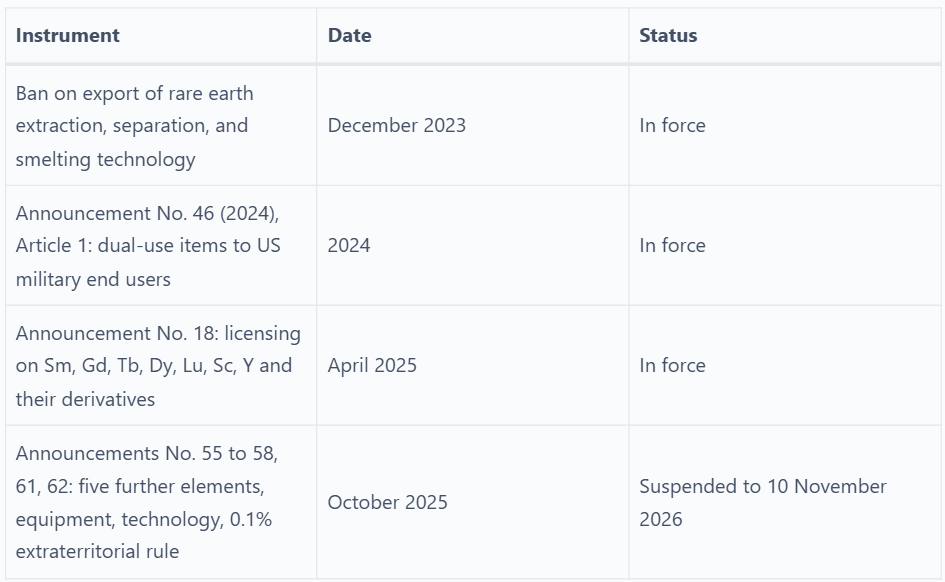
In November 2026, the suspension of the measures regulating rare earth exports that China adopted in October 2025 will expire. 1,2 With these measures, five additional elements have been added to the control list, bringing the total number of controlled elements to twelve of the seventeen rare earth elements, along with controls on rare earth processing equipment and the technology itself, in addition to an extraterritorial rule requiring a license for any magnet manufactured abroad that contains as little as 0.1% of contolled rare earth elements of Chinese origin or is manufactured using Chinese processing technology. 1,2 The suspension was part of a mutual truce reached at the Busan summit in late October 2025, and the measures remain on the books, dormant and reactivatable. Hence, the countdown.
However, the measure with the greatest practical impact was never suspended at all. The Chinese restrictions of April 2025, issued as Announcement No. 18 by the Ministry of Commerce and the Customs Administration, put seven medium and heavy rare earth elements, together with their metals, oxides, alloys, compounds, mixtures, and magnet materials, under an export licensing regime granted on a case-by-case basis, and that regime has remained fully in effect throughout the truce. And this licensing system, logically, generates costs on the applications it approves, not only on the ones it rejects, since the statutory review target of 45 working days runs to 60 or 120 days in practice for heavy rare earths, and the application itself requires the exporter to disclose the full manufacturing value chain, the final application, and authenticated customer identity. 3,2 The general licenses granted to a handful of authorized Chinese manufacturers (among them JL MAG, Zhongke Sanhuan, and Ningbo Yunsheng) starting in December 2025 provided access to civilian customers; however, the applications involving users in the defense and aerospace sectors were basically rejected.4
The practical consequences I saw through the different documentation seem to mainly concern yttrium, dysprosium, and terbium. While yttrium is employed for high‑temperature coatings and specialized ceramics in aerospace and power generation, dysprosium and terbium are used for high‑performance permanent magnets in electric vehicle motors, wind turbines, and advanced industrial equipment. The reports from the CSIS show that shipments of yttrium to the United States fell from more than 300 tons in the eight months prior to the April restrictions to approximately 15-20 tons in the eight months following them, forcing aerospace manufacturers to ration their use of yttrium.3 And by mid-2026, BMI data put yttrium, dysprosium, and terbium shipments to the United States at roughly 42, 41, and 49%, respectively, of their pre-restriction volumes 5. Meanwhile, at two consecutive summits of world leaders, Washington has characterized the rare earth issue as essentially resolved, while Beijing’s Ministry of Commerce has avoided mentioning rare earths in its own announcements. 3,6
Table 1 gives the reader an overview of the different announcements.
I want to use these policies to guide your attention toward explaining why a licensing regime targeting a handful of little-known elements can exert influence over car manufacturers, turbine builders, semiconductor companies, and defense contractors, and why that influence remains basically intact following the truce set to expire in November 2026.
2. Rare Earths are not so rare, but…
Despite their name, the seventeen rare earth elements are geochemically widespread. On their own, cerium and neodymium are more abundant in the Earth’s crust than copper, and both exceed gold and silver by several orders of magnitude 7. The name is a legacy of the 19th century, and the reason was that these elements are rarely found in concentrations dense enough for profitable extraction and almost never in pure form; and, ironically, this is what makes them “rare” at the end of the supply chain.
The U.S. Geological Survey estimates that global reserves exceed 90 million tons of rare earth oxide equivalent, distributed across all continents (data updated in 2026).8 China holds the largest single share, with about 44 million tons (Mt), followed by Brazil, with approximately 21 Mt; India (~7 Mt); Australia (~6 Mt); and other reserves in Russia, Vietnam, and the United States.9 The IEA warns anyways that this map is a snapshot influenced by geology, national reporting standards, and what was considered economically viable at the time each study was conducted.9 Deposits that are not economically viable at a certain price become reserves at another price, meaning that, in practice, the map varies depending on market conditions. However, this does not detract from the fact that the reserves are rather large.
Therefore, if the bottleneck were purely geological, it would primarily be a mining problem, and mining capacity can, in principle, be diversified: the Mountain Pass mine in California and the Mount Weld deposit in Australia are examples of high-grade rare-earth operations outside China. The challenge with rare earth elements lies in the fact that the deposits are mined and processed as mixtures of co-produced elements whose composition is dictated by the mineralogy of the ore: many economically significant deposits are dominated by lower-value light rare earth elements (LREE), particularly cerium and lanthanum, while containing only modest proportions of the higher-value heavy rare earth elements (HREE) needed in modern advanced technologies.
For instance, the dominant LREEs are used primarily in relatively mature applications with lower profit margins (such as cerium in glass polishing powders, glass additives, and catalysts, and lanthanum in catalysts for oil refining, optical glass, and nickel-metal hydride batteries), while a large share of added value is concentrated in less abundant elements, such as neodymium, praseodymium, dysprosium, and terbium. Neodymium and praseodymium, in particular, are essential to high-strength permanent magnets used in electric-vehicle drivetrains, wind-turbine generators, hard-disk drives, and other compact high-power systems, while dysprosium and terbium are added to certain magnet chemistries to improve their performance at elevated temperatures.
This makes the HREEs behave economically more like constrained co-products than stand-alone primary commodities.
The industry refers to this structural mismatch between natural element ratios and market demand as the basket problem.
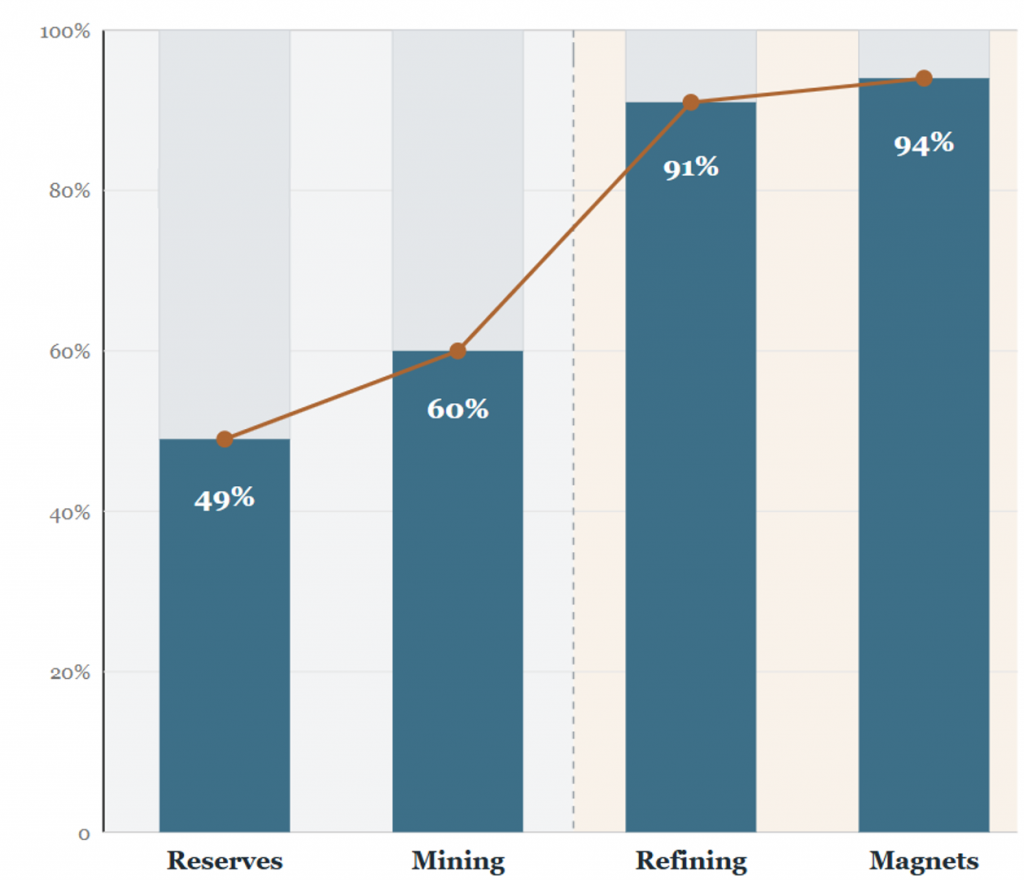
The bottleneck in rare earths lies in the subsequent stages of the supply chain, particularly separation and refining, as we will see in detail in the next section. And in the following stages of the chain, China once again becomes the main player. Note that by 2024 (Figure 1), even at the rare-earth extraction stage, China accounted for 60% of the global share. But we’ve already seen that mining operations can be diversified. When it comes to refining, dear readers, its share rises to 91%. And in the production of permanent magnets, that share reaches 94%, roughly twice its share in 2005.9 And considering that magnet rare earths alone represent a market of about US$6.4 billion, while underpinning end‑use industries with economic value in the trillions of dollars,9 it becomes clear why export restrictions on rare earths and permanent magnets carry such significant geopolitical weight.
3. Rare Earths: Dirty Separation for a Green Economy. Why China Built the World’s Rare Earth Separation Infrastructure.
A characteristic property of rare earth elements is that they typically exist together in the same minerals and, from a chemical perspective, are significantly similar. Most lanthanides are found predominantly in a single stable oxidation state, the trivalent 3+ cation, with only a few exceptions, such as cerium, which also forms stable 4+ species, and europium, which can adopt a stable 2+ state. Since their chemical behavior is dominated by the same charge state, the standard industrial strategy of separating metals by exploiting large differences in oxidation state or redox behavior is much less effective in this case. Copper, for example, is effectively purified by electrolysis; iron can be selectively reduced from its oxides; and uranium is separated by alternating between multiple accessible oxidation states. With redox reactions ruled out, the only remaining criteria used in modern processes rely primarily on ionic size, and even then, the differences are minimal.
As you move from lanthanum to lutetium along the series, the ion of each element becomes slightly smaller in a very gradual, almost regular way, so that each one differs from its neighbor by, at most, a small percentage. This steady decrease, called lanthanide contraction, is caused by the fact that the electrons characterizing these elements do not “shield” well against the attractive force of the nucleus. However, it is precisely these small differences that modern separation processes (using liquids and resins that favor one ion over another) exploit to convert mixed rare-earth concentrates into the individual elements used in magnets, batteries, and other energy technologies.10
3.1. The chemistry of rare earth separation
Minerals such as bastnäsite and monazite typically contain less than 10% rare earth oxides (REO), and physical enrichment processes such as crushing, flotation, and magnetic separation transform them into concentrates containing approximately 50% to 60% REO. Up to this point, rare earth processing resembles any other mining operation, as do its waste products, which are flotation tailings of up to 40 metric tons per metric ton of REO, which are dumped into open-air waste deposits.11
That concentrate undergoes a cracking process, in the Baotou process in China, through treatment with sulfuric acid, followed by leaching, to dissolve the REO into a mixed solution of chlorides, sulfates, or nitrates. The actual separation is then carried out through solvent extraction. In simple terms, this process moves metal ions back and forth between an aqueous phase and an organic phase containing special extractant molecules (usually organophosphorus reagents). Each contact between the two phases shifts the equilibrium very slightly in favor of one element over its neighbor. Since adjacent lanthanides are so similar, the separation factor (a measure of how much more one element prefers the organic phase over the other) is close to 1, meaning that a single extraction step barely improves purity.12
The only way to obtain high-purity and magnet-grade material is through iterations: long chains of mixer-settler units connected in countercurrent cascades, in which each section (extraction, washing, separation) consists of between a dozen and several dozen stages, and a complete plant can easily reach hundreds of stages in large Chinese configurations. From an economic perspective, a rare-earth separation plant is not so much a single chemical reactor as a very long and very acid ion-exchange assembly line, which explains both its capital intensity and its waste footprint, both of which we will examine in greater detail in the following sections.13
The logical consequence of the repeated use of organic solvents and highly acidic solutions is the generation of a very large volume of waste, which I would classify into three main categories:
Acidic process water. Acid is used at every stage. Statistics from the China Rare Earth Society regarding the sulfuric acid treatment, for instance, reveal that for every ton of rare earth concentrate processed, roughly 9,600 and 12,000 m3 of waste gases containing fluoride, SO₂, SO₃, and dust are generated, along with about 75 m3 of acidic wastewater and approximately one ton of radioactive waste. The wastewater contains dissolved heavy metals, ammonium from the saponification and precipitation stages, and residual salts in concentrations that make conventional treatment costly and technically challenging. 14
Radioactive solids. Rare-earth minerals often contain small amounts of actinides such as thorium and, in some deposits, uranium within the same crystal lattices. When the ore is cracked and leached, rare earths and actinides are released together, and the actinides end up in the waste. At Bayan Obo, the deposit that supplies Baotou, this accumulates on a huge scale: an 11 km2 waste reservoir containing approximately 180 Mt of fine processing residue… which grows by 7-8 Mt annually according to official reports and is contaminated with thorium, unlined, without vegetation cover, and located about 35 m above the Yellow River.15
Organic losses. The extractants and diluents used in solvent extraction gradually degrade in the harsh environment of strong acids and, to a lesser extent, under radiation. As they break down, they migrate into aqueous streams or volatilize into the air. These losses represent not only an operating cost for the plant but also a source of diffuse pollution for the surrounding environment that is hard to monitor and even harder to remediate.
I want to highlight that this waste profile varies depending on recovery yield, and the process improves only gradually. The thermodynamics of the separation of almost identical ions set a hard limit on the number of stages, the amount of reagent, and the volume of effluents you need, although there is a growing body of scientific literature addressing the optimization of rare earth separation. For now, most of that research remains at the laboratory scale and will be the subject of a future Raw Science article.
Therefore, whoever carries out large-scale separation processes inevitably inherits the resulting waste. If the world wants high-purity rare earths, someone has to carry out time-consuming, chemically intensive processes and manage the byproducts they generate.
Today, China has taken on, and continues to take on, the largest share of that responsibility, which means that it not only dominates the midstream segment but also carries much of the environmental cost embedded in global clean‑tech supply chains.
3.2. The Chinese hegemony: inherited, optimized, industrialized
China’s global leadership in rare earth separation is not a matter of luck; rather, it is the result of decades of deliberate research, imitation, optimization, and scaling. Modern separation methods themself emerged from U.S. research in nuclear chemistry and hydrometallurgy16,17 and its industrial refinement for rare earths was largely driven by France. The Rhône‑Poulenc plant at La Rochelle, later operated by Rhodia (the French specialty‑chemicals company that became part of Solvay), could produce the full suite of rare earth elements essentially at high purities, using almost exclusively solvent‑extraction circuits. Throughout the 1980s, the French process was the industry standard, and Chinese plants drew directly on the French approaches.
And Western plants, like the one in La Rochelle, did indeed demonstrate that solvent extraction could produce ultra-pure rare earths, but they did so by using large amounts of metal, going through numerous stages, and through a process of trial and error.12 China built on that foundation and asked a different question: How can we carry out the same chemical process faster, cheaper, and on a larger scale? In the 1970s, Xu Guangxian of Peking University began redesigning the most difficult separation among the light rare earth elements (LREE), specifically the praseodymium/neodymium pair.18 Instead of building more and more pilot plants, his team turned the separation problem into a computable design challenge: how many stages, what operating points, what flow rates.18 Once these models were encoded into the software and implemented in Chinese plants, the process, which had previously taken months to complete, could be done in a matter of days, and the separation cascades could be scaled directly from the drawing board to industrial scale. By the mid‑1990s, China was supplying most of the world’s high‑purity rare earths and steadily shifting the industry’s center of gravity eastward.19
And finally, what gave China the last step to its leadership was mostly a policy issue: Western firms saw that, given their own policy and cost environment, it was more profitable to offshore the dirty midstream to China and secure supply contracts than to keep running capital‑ and pollution‑heavy plants at home. So, under pressure from low-cost Chinese raw materials, rising environmental and regulatory costs in Europe, and the temptation of secure access to Chinese raw materials and markets, Rhodia ultimately opted for partnership with China over competition and, in 2011, signed a strategic alliance with Chinalco’s rare-earth subsidiary that explicitly combined Chinese supply with French technology and market development.20,21
Between 1950 and October 2018, Chinese entities recorded more than 25,000 patents related to rare earths, compared with approximately 10,000 in the US,22 and their practical experience now spans process engineering, reagent management, impurity control, plant design, and operational know-how that can only be acquired after decades of operating countercurrent circuits. The consequence is well known: as Chinese separation technology matured, the global bottleneck shifted to the later stage of the process, moving from ore to processing. And anyone involved in the rare earth and magnet industries is well aware of this.
By the mid-2020s, IEA estimates place China at around 91% of refined rare earth production,23 and in the case of heavy rare earths, the concentration is nearly total, as analyses by Benchmark Mineral Intelligence and reported by Reuters place China at approximately 99% of global heavy rare earth processing capacity, even though with a declining trend (projected at ~91% by 2030).24
Theory and technical expertise explain why China can separate rare earth elements cheaply and efficiently. However, they do not explain why almost all of the world’s rare earth separation takes place there. France had everything it needed to achieve that dominance. However, a capacity of this magnitude requires someone to take charge of the above-mentioned waste streams, and China, unlike the West, found a compromise.
Continue reading with Pro
This analysis is reserved for Raw Science Pro members.
- The hidden environmental subsidy: How the Chinese rare earth industry operated at a massive full-cost loss for decades, and why the true price of Western “green” tech was paid in toxic groundwater.
- Decomposing the Western price shock: A financial breakdown of the ex‑China premium on heavy rare earths, separating structural compliance costs from temporary geopolitical rent, and showing what this implies for future Dy/Tb price paths.
- The Myanmar displacement: Why China’s domestic “greening” effort is largely an externalization strategy that shifts the most toxic extraction to an unregulated conflict zone.
- The true barrier to Western reshoring: Why offtake agreements won’t save new Western separation projects if they can’t solve the radioactive waste and wastewater math that killed the industry in the 1990s.
References
- Anderson H, Shi H. (2026) China’s Export Control Architecture and Its Use of Critical Minerals as Strategic Pressure Points. Andersen Institute Notes.
- Pillsbury Winthrop (2025), .China Suspends Export Controls on Certain Critical Minerals and Related Items.
- Baskaran G, Schwartz M. (2026) Rare Earth Export Restrictions One Year Later. CSIS Brief.
- China Briefing (2025), How Will China’s Rare Earth Export Controls Impact Industries and Businesses?
- Mining.com (2026) China’s rare earth grip persists despite Trump-Xi summit, BMI says.
- Research and Markets (2026), The Global Rare Earth Magnets Market 2026-2036.
- Sager, M., & Wiche, O. (2024). Rare Earth Elements (REE): Origins, Dispersion, and Environmental Implications: A Comprehensive Review. Environments, 11(2), 24. DOI: 10.3390/environments11020024.
- U.S. Geological Survey. (2026) Mineral Commodity Summaries 2026. DOI:10.3133/mcs2026.
- IEA (2026) Rare Earth Elements. Pathways to secure and diversified supply chains. [PDF].
- Traore, M. et al. (2023)
Research progress of rare earth separation methods and technologies, Journal of Rare Earths, 41 (2),182-189. DOI: 10.1016/j.jre.2022.04.009. - Pyrgaki, K. et al. (2021) Geochemical Occurrence of Rare Earth Elements in Mining Waste and Mine Water: A Review. Minerals. 11(8), 860. DOI: 10.3390/min11080860.
- Qi, D. Hydrometallurgy of Rare Earths. Separation and Extraction. Elsevier Inc. 2018. DOI: 10.1016/C2016-0-05328-7.
- Xie, F. et al. (2014) A critical review on solvent extraction of rare earths from aqueous solutions. Minerals Engineering, 56, 10-28. DOI: 10.1016/j.mineng.2013.10.021.
- Hurst, C. (2010) China’s Rare Earth Elements Industry: What Can the West Learn? Institute for the Analysis of Global Security (IAGS). DOI: 10.21236/ADA525378.
- Li, K. et al. (2015) Contamination and health risk assessment of heavy metals in road dust in Bayan Obo Mining Region in Inner Mongolia, North China. Journal of Geographical Sciences. 25, 1439-1451. DOI: 10.1007/s11442-015-1244-1.
- Ritter, S.K. (2017) A whole new world for rare earths. c&en News, 95, 34.
- Jerome, A. (2025) Rare Earths and the Bomb – How the Manhattan Project hatched today’s rare earth industry. Lipmann Walton & Co LTD.
- The Royal Society of Chemistry. (2021) Rare earth chemistry – In memory of Professor Xu Guangxian on the centenary of his birth, Inorg. Chem. Front. 8(1), 10-11. DOI: 10.1039/d0qi90084b.
- Pekin University News. (2019) [70 years on] Xu Guangxian: Father of Chinese rare-earth metal.
- SpaceWar. (2011) Rhodia announces rare earths deal in China.
- Reuters. (2011) Solvay signs rare earths deal with Chinalco.
- Rare Earth Exchanger (2026) China Owns the Patent High Ground in Rare-Earths
- IEA (2026) Rare Earth Elements Report.[PDF]
- Onstad, E. (2025) West scrambles to fill heavy rare earth gap as China rivalry deepens. Reuters.