Series: Critical Analysis of Uranium: The Fuel-Cycle Squeeze, Part 1 of 4.
Table of Content
- Uranium Enrichment… Not Only the Mine
- The four steps nobody watches
- Why can't you just dig up reactor fuel?
- SWU: the separation and enrichment unit
- The dial: feed versus work
- The geopolitical situation of uranium enrichment: will we need more or less mining?
- Russia's quiet centrality and the 2024 policy shock
- The chain that almost nobody draws
- What would break this thesis?
- Editorial Note
- References
Uranium Enrichment… Not Only the Mine
Uranium is not like copper or silver. For most metals, extraction is the key stage: the ore is identified, mined, and the price and power follow the rock. Uranium is different. The fuel goes through four stages between the deposit and the reactor (extraction, conversion, enrichment, and fabrication), and the power to influence lies in the intermediate stages, in the hands of a limited bunch of countries and companies, not underground. This series sets aside the well-known simplistic formula of “more reactors, more mining” and traces the journey of the fuel throughout the entire chain, because the forces that truly drive uranium (both physical and geopolitical, and often hidden in the stages that most reports omit) are rarely found in the mine.
There is a number that follows uranium around like a shadow: Kazakhstan produces about 40% of the world’s uranium 1. It is repeated in every market note, every explainer, every nervous headline about supply security. It is, indeed, true and worth being aware of… But it answers the wrong question.
The 40 percent figure refers exclusively to mining, that is, extracting uranium from the ground as ore, which is milled into a coarse powder called yellowcake that is virtually useless as fuel without further processing. And almost nothing that makes the uranium market tight, strategic, or politically dangerous happens at the mine. It happens later, in a series of unglamorous industrial steps that transform raw uranium into something a reactor can actually use: Low-Enriched Uranium, or LEU, in which the concentration of the fissile isotope U-235 is raised to roughly 3–5% for the conventional reactors and, to just under 20% for the High-Assay Low-Enriched Uranium, HALEU, that the Chapter 2 of this series will cover. That middle of the chain is where the real concentration lies, and where, as we will see, Russia wields leverage. And it is where, over the past three years, a quiet mechanical shift has done something most observers would call impossible: a set of sanctions aimed at enrichment has raised global demand for mined uranium… without a single new reactor being built.
To see how, we have to leave the mine and follow the atom.
This is the first of four pieces on what I’m calling the fuel-cycle squeeze series. This first part covers the middle of the chain: enrichment, Russia’s grip on it, and a hidden dial (the tails assay) that silently sets how much mined uranium the world needs. The second part focuses on the fuel that the next-generation reactor fleet will use (HALEU) and on why small reactors, artificial intelligence data centers, and space missions are about to compete for the same scarce supply. The third part returns to the topic of resources: how is it possible that the world has abundant underground uranium reserves and, at the same time, faces a supply shortage, and why is recycling presented as a solution when, in fact, it is currently not yet a solution. The fourth part discusses the mechanics from a market perspective: where each bottleneck is located, which companies are involved, and what factors would confirm or refute the hypothesis.
The four steps nobody watches
Between a uranium mine and a working reactor are four industrial stages, and they are not interchangeable: each is a separate business, with separate plants, separate bottlenecks, and a very different geography:
- Mining produces yellowcake, a coarse powder of uranium oxide (U₃O₈), which is the form uranium takes when it leaves the processing plant. This is the stage that everyone tends to follow closely.
- Conversion transforms yellowcake into uranium hexafluoride (UF₆), a compound that sublimates (transitions from a solid to a gas) at moderate temperatures.
- Enrichment takes that UF₆ gas and raises the share of the fissile isotope, U-235, from its natural 0.7% toward the 3–5% a conventional reactor needs.
- Fabrication converts the enriched uranium into a solid ceramic (uranium dioxide, UO₂), presses it into pellets, and seals them into the metal tubes (fuel rods) that go into a reactor.
The geopolitical shape of these four steps is the whole story because it is wildly uneven.
Mining is indeed the most diffuse: It is spread across roughly a dozen countries, led by Kazakhstan (~40%) and Canada (~24%), and dominated at the company level by four producers: Kazatomprom (Kazakh state), Cameco (Canada), Orano (France), and CGN (China), which together account for more than half of world output. 1 But just look at who these four key players are: a Kazakh state-owned company, two Western companies, and one Chinese company, while the Russian mining subsidiaries (Rosatom’s Uranium One and ARMZ) are left just outside the group. No single bloc controls the mine on its own. This is the aspect that everyone tends to focus on, and where control is actually most fragmented… which is precisely the smokescreen that this series is about. Fabrication, at the far end, is similarly spread across about a dozen countries and currently sits in overcapacity, meaning the supply comfortably exceeds demand, prices are soft, and utilities can shop between suppliers 2 This is a beneficial market for buyers, not a true bottleneck, with one exception: Russian-designed VVER reactors require fuel assemblies specific to Russia, which historically have been manufactured only by Rosatom’s TVEL, a monopoly that Western manufacturers have only recently begun to break for Eastern European operators who inherited Soviet-era fleets. Between these two open ends sit the two pinched ones. Conversion runs through just five commercial plants on Earth: Canada (Cameco), China (CNNC), France (Orano), Russia (Rosatom), and the United States (ConverDyn) 2 three in Western-allied hands, one Russian, one Chinese. And enrichment, the most strategically sensitive step of all, runs through only four commercial suppliers worldwide: Russia’s Rosatom, the European consortium Urenco, France’s Orano, and China’s CNNC.3
Four suppliers, but one of them dominates the market. Russia accounts for between 40% and 46% of global enrichment capacity: the U.S. Department of Energy used an approximate figure of 44% when justifying the ban on Russian fuel 4, and a peer-reviewed assessment from 2025 puts it at 46% 5. That dominance is not the result of geology, prices or causality: it stems from the industrial infrastructure inherited from the Soviet era, which the West chose not to compete with. Rosatom operates four enrichment complexes with a combined capacity exceeding 27 million SWU per year,3 built during the Cold War and kept at full capacity throughout the 2000s by supplying the West with cheap enrichment services that made developing rival Western capacity seem economically unfeasible. The result is a supplier that is not only large but also structurally inexpensive: Russian enrichment has undercut the market for two decades, thereby undermining the incentive for any other player to expand. Replacing it, therefore, means not only matching its capacity but also rebuilding an industry that Russian competition had deliberately kept small, which is why, as we shall see, the transition takes years rather than months.
So the “40%” that should worry a Western utility isn’t Kazakhstan’s share of the mine. It’s Russia’s share of the step that turns uranium into fuel.
How can a bottleneck in enrichment increase the demand for mined uranium?
It seems irrational: a problem at one stage of the chain affecting another stage to the point of causing demand to rise. But it isn’t irrational once you understand the underlying mechanism, and that mechanism revolves around two terms most people have never heard of: underfeeding and overfeeding. To get to that point, we need to start by explaining why and how uranium must be enriched.
From there, the paradox resolves itself.
Why can’t you just dig up reactor fuel?
Natural uranium is a mixture of isotopes: atoms of the same element that are chemically identical but differ in mass because they have a different number of neutrons in their nuclei. Two of these isotopes are important when it comes to nuclear fuel. Uranium-235 is the fissile isotope: when it receives a neutron, it splits, releasing energy and more neutrons, which sustain a chain reaction. Uranium-238 is the inert ballast: in a conventional reactor, it basically just sits there doing nothing. The main issue is the enrichment level. Natural uranium contains approximately 99.3% U-238 and only about 0.7% U-235, and a conventional nuclear reactor requires the proportion of U-235 to be increased to approximately 3–5%. Therefore, before uranium can be used as fuel for anything, someone has to enrich the useful isotope: take a mass containing 0.7% U-235 and convert it into one containing 4 or 5%.
But, as I have already mentioned, U-235 and U-238 are the same element. They have the same number of protons, the same number of electrons, and the same chemical properties. It is not possible to separate them through any chemical reaction, since, from a chemical point of view, they are indistinguishable: there is no solvent, no membrane, and no reaction that favors one over the other. The only thing that differentiates them is their mass, and the difference in mass is just over one percent. Enrichment is, therefore, the industrial process of sorting atoms based on a one-percent difference in mass, repeated billions and billions of times.
The method that now dominates the industry is the gas centrifuge: that is, spinning uranium so fast that the heavier atoms edge outward from the lighter ones.
Why a gas centrifuge? And not directly from the powder?
In its solid form, such as yellowcake (mainly ), uranium isotopes are locked into a rigid crystal structure. Under these conditions, physical processes like rotation cannot separate the isotopes, because the material behaves as a single mass rather than allowing individual atoms or molecules to move independently. For isotope separation to work, uranium must be in a phase where its particles can respond individually to external forces. This is achieved by converting uranium into uranium hexafluoride (), a compound that becomes a gas at relatively moderate temperatures, and in the gaseous state, uranium exists as discrete molecules that move freely. When this gas is subjected to high-speed rotation in a centrifuge, a small but crucial mass difference comes into play: the molecules containing the heavier U-238 isotope tend to move slightly outward, while those containing the lighter U-235 concentrate closer to the center. This is why the conversion step exists: uniquely combines chemical stability with sufficient volatility, making it suitable for large-scale isotope separation using gas centrifuge technology.
The challenge is that the mass difference between U-235 and U-238 is extremely small, so a single centrifuge achieves only a minimal degree of separation. To reach useful enrichment levels, the process is repeated in interconnected sequences known as cascades. In these systems, the slightly enriched output from one centrifuge becomes the input for the next, with thousands of units operating in series and parallel configurations. Each stage incrementally increases the concentration of U-235, ultimately reaching the 3–5% enrichment required for most nuclear reactors. This is why enrichment is a four‑company business, not a four‑hundred‑company business. The centrifuges are slow, brutally precise, capital-intensive to build and qualify, and inherently dual‑use: the same machines that quietly turn out 3-5% reactor fuel can, with more stages and time, be driven up to roughly 90% weapons‑grade uranium. That reality puts the whole sector behind layers of nonproliferation walls (export controls, IAEA inspections, and treaty obligations) that decide who is allowed to own this capability. The supply shortage in this case is not a market coincidence; it is determined by the physical laws governing isotope separation and is further reinforced by nuclear safety policies.
SWU: the separation and enrichment unit
Enrichment is measured as effort, not as kilograms of uranium, so the industry uses its own unit: the separative work unit, or SWU, which does not tell you how much uranium you have but how much isotopic sorting you have done: conceptually closer to a unit of work than a unit of material. If you imagine natural uranium as flour full of mixed grains, enrichment is the sieve that separates the fine fraction (U‑235) from the coarse (U‑238). SWU measures how hard and how long the sieve is shaken, not how many kilograms of flour you started with or ended up with.
Every enrichment operation, then, produces three distinct material streams, and I would keep them clear since they are key to understanding the next sections:
- Feed: the natural uranium you put into the enrichment plant.
- Product: the enriched uranium you take out (the final 3–5% U‑235).
- Tails: the depleted uranium that comes out the other end, mostly U‑238 with a small residual amount of U‑235 that was not captured into the product.
The U‑235 fraction that you allow to remain in the tails, the so-called tails assay, is a genuine control mechanism. By choosing how lean or how rich you let the tails be, you change how much natural uranium the world must mine and convert to support a given amount of reactor fuel, even if reactor demand and operating conditions stay the same.
The dial: feed versus work
To make a given amount of reactor fuel, you can run the process two ways:
You can run the tails lean: chase down nearly every atom of U-235 and leave very little behind. Do that, and you need less feed (you wasted almost nothing), but it costs you more separative work, because squeezing the last U-235 out of a stream that’s already mostly U-238 is exhausting work for the centrifuges.
Or you can run the tails rich: you stop early, and leave more U-235 in the discard pile. Now you need more feed (you threw usable uranium away), but you spent less separative work to get there.
So feed and work trade off against each other. More work lets you get away with less uranium. Less work forces you to burn more uranium. The tails assay is simply where you choose to sit on that seesaw, and the rational place to sit depends entirely on which input is cheaper at the moment: mined uranium or enrichment capacity.
When enrichment is cheap and plentiful (as it has been in the era when large Russian centrifuge complexes could sell vast amounts of low‑cost SWU into the global market), the economics say: use lots of work, run the tails lean, and save uranium. Enrichers choose low-tails assays and spend extra separative work to strip more U‑235 out of each kilogram of feed, and in some cases even reprocess old tails piles to scavenge additional U‑235. Because contracts usually assume a higher transactional tails assay, an enricher operating this way consumes fewer tonnes of natural uranium than the paperwork implies and captures a surplus it can keep or sell.
This is known as underfeeding and behaves like a hidden secondary mine: it manufactures uranium‑equivalent out of extra work and effectively adds supply, pushing primary demand and prices down.
When enrichment is scarce and expensive (as in today’s Western market, where Urenco, Orano and others must replace sanctioned Russian SWU with more limited, higher‑cost capacity), the logic flips. Now separative work is the precious input, so you conserve it: you run the tails rich, accept more U‑235 going out in the waste stream, and feed in additional uranium to keep product volumes unchanged.
This is overfeeding and it creates additional demand for uranium that would not exist if enrichment capacity were inexpensive, which further exacerbates the shortage all the way back to the mines.
The reactors are structurally the same, and the fuel supplied is the same, but by turning this one dial (the actual tails assay used in the cascades), the world’s annual uranium requirement can move by many thousands of tonnes, almost entirely invisibly, through a setting on the enrichment plants that no headline ever reports.
Let´s see it in numbers
To give a sense of scale, Table 1 shows how much uranium feed and separative work are required to produce 1 kg of 4.5% enriched uranium from natural uranium (0.711% U‑235) at different tails assays. At a low tails assay of 0.15% U‑235, the plant would use about 7.75 kg of feed but must invest 8.28 SWU per kilogram of product; at a higher tails assay of 0.35%, it needs about 11.50 kg of feed but only 6.09 SWU.
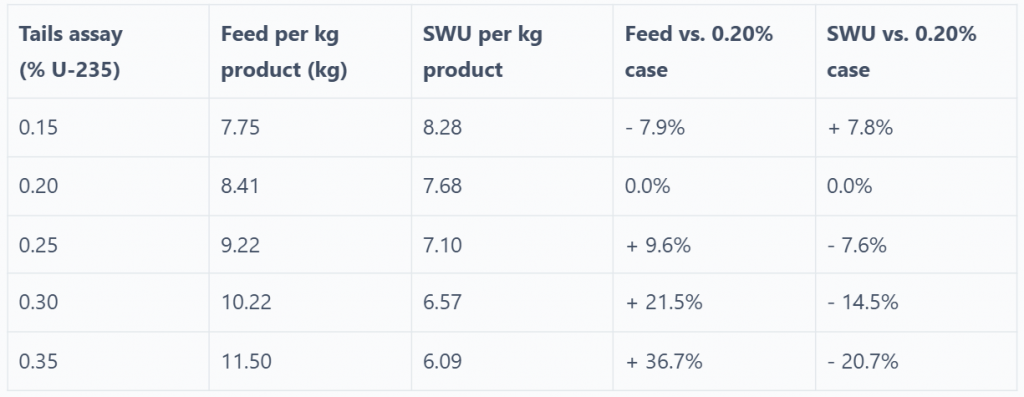
The last two columns express these changes relative to a 0.20% tails case. Dropping the tails from 0.20% to 0.15% cuts the feed by roughly 8% but increases SWU demand by almost the same amount; pushing the tails up to 0.30% raises the feed by about 22% while reducing SWU by around 15%. In other words, the tails assay is a very efficient dial: for a fixed fuel specification, each notch down on tails saves thousands of tonnes of uranium at the cost of additional separative work, and each notch up does the opposite.
To make this concrete, a 1,000 MWe light‑water reactor typically needs on the order of 100,000 SWU per year. At a tails assay of 0.20% U‑235, that corresponds, using the ratios in Table 1, to roughly 13 tonnes of 4.5% fuel (product) and about 109 tonnes of natural uranium feed. If you keep the SWU constant but relax the tails to 0.30%, the same 100,000 SWU now support around 15 tonnes of fuel and about 155 tonnes of natural uranium feed. In other words, for a single reactor, shifting tails from 0.20% to 0.30% quietly adds on the order of 40–50 extra tonnes of uranium per year: scaled to an entire fleet, that is many thousands of tonnes of additional mining and conversion for the same electricity output.
In the years when Russian SWU dominated the market, as we will see in the next section, Russian export contracts often assumed relatively lean tails around 0.20–0.25%, allowing global utilities to underfeed and effectively create secondary uranium supply. Today, with Russian enrichment restricted and Western capacity tight, Western plants are operating closer to a rich‑tails regime (approx. 0.25–0.30% or higher), conserving scarce SWU by burning through more mined uranium for the same reactor output.
The physics in Table 1 is therefore not abstract: it is exactly how a few tenths of a percent on tails can turn into many thousands of tonnes of extra uranium per year at the system level without a single new reactor.
The geopolitical situation of uranium enrichment: will we need more or less mining?
The decades of underfeeding and Russian cheap enrichment
For roughly ten years after the Fukushima accident in 2011, the dial sat firmly on underfeed, and this is one of the underlying reasons why the uranium market remained so stagnant for so long. Fukushima took Japan’s fleet offline and chilled nuclear programs across Europe; reactor demand fell, and a supply surplus emerged. Enrichment capacity, meanwhile, was abundant, and since shutting down and restarting centrifuges is costly, the plants continued to operate for a market that no longer needed their output. The spot price of the SWU reflects this oversupply in a single trend: approximately $160 per SWU in 2010, about $60 in March 2016, and even lower before the cycle turned around.3
And so the enrichers responded rationally. They ran their tails lean, underfed their contracts, and sold the surplus uranium into an already oversupplied market. The World Nuclear Association’s 2021 Nuclear Fuel Report estimated that underfeeding had the potential to contribute more than 6,000 tU per year to the world markets (a virtual mine larger than most physical ones!) with much of the potential concentrated in Russia, where operational tails assays were routinely run down to 0.10% U-235, against typical Western assays around 0.22% at that time.3,6 On top of that, Russian plants spent years re-enriching depleted tails, including 10,000–15,000 tonnes per year of Western-owned tails material, stripping it from over 0.3% down to 0.1% and recovering thousands of tonnes of natural-uranium-equivalent annually.6 And beneath all of it lay the older stack of secondary supply: utility inventories accumulated in better years, and the down-blended remains of Cold War warheads that the Megatons to Megawatts program had quietly fed into Western reactors for two decades.7
Add it up, and you get the strange arithmetic that defined the 2010s: mines produced substantially less uranium than reactors consumed, and it did not matter. As recently as 2022, primary mine production covered only about 78% of reactor requirements; by 2024, the figure had recovered to roughly 90%, with the balance still drawn from the secondary stack.8 The deficit was real. It was simply being paid out of savings, and the savings looked unlimited.
But they were not.
Two of the most important components of the secondary cycle, Russian underfed uranium and the re-enrichment of Russian waste on behalf of the West, depended on a geopolitical assumption: that Russian separation capacity would remain inexpensive and, more importantly, would be reliably available to the West.
That assumption, as we all know, ended in February 2022.
Russia’s quiet centrality and the 2024 policy shock
To understand what broke, you have to understand how deep Russia sat in this system, not as a miner, where it is middling, but in the middle of the chain.
Rosatom runs four enrichment plants with a combined capacity of well over 27 million SWU per year.9
Russia, in other words, wasn’t just a large enricher. It was the world’s low-cost provider of the very underfeeding-style services that suppressed uranium demand.
Think that as of 2023, Russia provided about 27% of the enriched uranium used by U.S. reactors4 and roughly 38% of the European Union’s.10
This is the dependency that the invasion of Ukraine turned from a commercial convenience into a strategic liability. The uranium itself was never really the issue: as said, the West can buy yellowcake from Canada, Australia, Namibia, and Kazakhstan. The issue was the middle of the chain, where the alternatives to Russia are few, expensive, and slow to build.
The Ukraine war and the consequences of uranium enrichment
And in May 2024, the United States acted… and this, to my mind, may reset the supply-demand balance of uranium over the next few years, which we still cannot see. The Prohibiting Russian Uranium Imports Act banned imports of Russian low-enriched uranium (LEU), but with an escape hatch: the Department of Energy can grant waivers where no alternative supply exists, and it has been using them. But those waivers run out on January 1, 2028, after which the ban holds absolute through 2040.11 Passing the law also released $2.72 billion in federal money to rebuild domestic enrichment and conversion, including $700 million ring-fenced for the high-assay fuel that Part 2 of this series is about 12, 13 Further, in January 2026, the DOE moved that money into contracts to expand domestic LEU and HALEU capacity over the coming decade.14
Europe is moving the same way, but by policy and market pressure rather than statute. Its May 2025 roadmap commits the bloc to phasing out Russian nuclear fuel, and utilities are already front-running it: Russia’s share of enrichment services delivered to EU reactors fell from 38% in 2023 to 24% in 2024 — measured in separative work, in a single year, as buyers shifted to Urenco and Orano.10 The West is, in effect, voluntarily removing its access to the largest and cheapest block of enrichment capacity on the planet.
And here is the twist that makes this moment consequential, rather than merely disruptive. This break is occurring precisely as nuclear energy enters its first real upswing in demand in a generation: reactor lifetime extensions, new constructions, and demand from data centers (which will be discussed later in this series) are all coming at once.
The West is doing away with its cheapest source of enrichment just when its need for enrichment is about to increase.
The chain that almost nobody draws
The consequences?
A sanction targeting the enrichment phase propagates backwards along the supply chain and becomes a demand event at the mine level. And the event is doubly leveraged, because it operates on both sides of the ledger simultaneously: the market loses the underfeeding supply stream and gains an overfeeding demand stream.
Sizing the event.
Nobody outside the enrichment companies observes operational tails assays directly, so any magnitude is modeled, not measured. But the model is just the mass balance that will be analyzed in the methodology appendix below. Global reactor requirements in 2025 are about 69,000 tU.8 A reasonable assumption is that 55–60% of those requirements are serviced by Western enrichers (Urenco, Orano, and U.S. plants) and are therefore exposed to Western SWU scarcity once Russian services are restricted.4,10 As a baseline, Western contracts in 2025 specified transactional tails assays around 0.20% U‑235.15 However, we expect higher Western tails assays going forward: with Russian SWU constrained, Western cascades must fuel more of the same reactor fleet with limited capacity. SWU prices then will rise, and enrichers respond by conserving work, that is, by operating at richer tails and making up the difference with additional uranium feed.
On the assumptions above, Table 2 shows that a “mild” overfeed regime, with average Western tails drifting from 0.20% to 0.25%, adds roughly 3,600–4,000 tU/yr of extra feed; a “full” overfeed to 0.30% adds roughly 8,100–8,900 tU/yr; and the disappearance of underfeeding removes up to another ~6,000 tU/yr of secondary supply.
| Scenario | Avg. Western tails assay | Incremental feed demand (tU/yr) |
|---|---|---|
| Mild overfeed | 0.20% → 0.25% | ~3,600–4,000 |
| Full overfeed | 0.20% → 0.30% | ~8,100–8,900 |
| Plus: loss of underfeed supply | — | up to ~6,000 |
| Combined swing (upper case) | ~14,000–15,000 |
Against the annual global requirements of ~69,000 tU, the combined upper‑case swing is on the order of 14,000–15,000 tU per year… Comparable to adding Canada’s entire uranium output to the demand side, through an operational setting alone. Even the mild case, at ~10,000 tU (including lost underfeed), exceeds the annual production of most operating mines.
That said, I want to stress that careful analysts will apply different assumptions regarding Western participation and the results of the analysis, and will arrive at results that are significantly higher or lower than those of this analysis; however, the table is intended to be a sensitivity analysis, not a forecast. What it demonstrates is that the mechanism is large enough to be relevant on a market-wide scale… which is precisely the point I wanted to show the reader.
Further, the timing is another uncomfortable part. The waiver window closes at the start of 2028, which means the West is living through the exact transition (losing Russian capacity faster than it can commission its own) during which overfeeding pressure is strongest. New Western capacity is coming: Urenco is delivering a 2.5 million SWU expansion program across its four sites, with new cascades already producing at Eunice, New Mexico, since 2025 and roughly 700,000 SWU/yr of added U.S. capacity due by early 2027 16; Orano is extending Georges Besse II and pursuing U.S. capacity; Centrus and Global Laser Enrichment are advancing American projects with DOE support.14 Centrifuge plants are modular, so enrichment scales faster than mines. But Euratom’s own assessment is blunt: the Western enrichment shortfall exceeded 9,000 tSWU per year as of the 2024 reporting cycle and only begins narrowing after 2027.10 “Faster than a mine” is not the same as “fast,” and the gap years are the squeeze years.
What would break this thesis?
A mechanism as transparent as this one deserves to be tested against observable data, and that data is contradictory. Three arguments challenge a simplistic version of this thesis, and any rigorous reader should take all of them into account.
European tails are still lean. The Euratom Supply Agency’s market data show EU enrichment deliveries in 2025 were contracted at an average tails assay of 0.20%, and the fuel actually loaded into EU reactors averaged 0.21% tails: squarely in the historical “cheap enrichment” range. Whatever operational assays Western enrichers are running internally, the transactional data do not yet show an overfeed. The mechanism has a fuse, and the fuse (inventory drawdown, contract rollovers, the 2028 waiver cliff) has not fully burned down.
The global enrichment balance is not the Western enrichment balance. The World Nuclear Fuel Report 2025 notes that on a global basis, enrichment supply exceeds demand into the early 2030s; the deficit is regional, created by the geopolitical segmentation of a formerly unified market. The overfeed thesis is therefore really a thesis about how completely the Western market walls itself off. Every leak in the wall, of course, weakens it.
Where there’s a law, there’s a loophole. After the U.S. ban, exports of enriched uranium from China to the United States surged from effectively zero in 2020–2022 to roughly 243 tonnes in a single month in December 2023, triggering concern that Chinese material was indirectly backfilling Russian supply. In this pattern, China can import large volumes of Russian enriched uranium for its own reactors while redirecting more of its domestic production to Western customers, effectively “swapping” origin. The statute’s prohibition on swaps was written to block exactly this kind of displacement, but enforcing it against indirect, multi‑country flows is difficult in practice. Trade data in 2025 already show Chinese purchases of Russian enriched products at a record level. If these displacement flows persist at scale, the true scarcity of Western-accessible SWU, and therefore the upward pressure toward overfeeding, is materially smaller than the headline ban would suggest.
None of this breaks the mechanism. Rather, it timestamps it. The direction is locked in by legislation and physics; the magnitude and the onset depend on the waiver runway, the leak, and how fast Western cascades commission. For readers who want to translate this into valuation implications, the more analytical investor treatment will come in Part 4, once the full series is assembled and the technical pieces are rolled up into a coherent thesis.
Editorial Note
This article explains a mechanism; it deliberately does not forecast a price. The direction of the underfeeding-to-overfeeding effect is well established in the physics and in industry behavior, but its magnitude is genuinely uncertain. Operational tails assays are commercially confidential, so the size of the swing is modeled rather than observed, and reasonable analysts disagree on how large it is. Conversion-price claims are directional; uranium and conversion both trade through private, assessed prices rather than open exchanges, so any single figure is indicative. Finally, the circumvention question, whether Russian material reaches the West through third countries, is, to date, unresolved and materially affects how hard the squeeze bites. Where this piece simplifies the chemistry (the gas-centrifuge description, the feed-product-tails seesaw), it does so to make the mechanism legible, not to imply the engineering is simple.
Methodology appendix: feed factor and SWU calculations
Every claim about feed and separative work in this article follows from two standard relations of enrichment. For a product of assay , drawn from natural feed of assay = 0.711% U-235 and leaving tails of assay , the feed required and the separative work required (both expressed per kilogram of product ) are:
Feed per unit product:
Separative work per unit product:
where V(x) is the value function, a measure of how far a given assay sits from a 50/50 mix:
The value function is what makes separative work independent of concentration; it rises steeply as x approaches 0 or 1, which is the mathematical reason enriching the last few percent toward weapons grade costs so little extra work once you are already high up the curve, a point that recurs in Part 2.
Worked basis. The tails-assay table (Table 1) evaluates both relations at a product assay of = 4.5%, sweeping from 0.15% to 0.35%. The market-scale estimates in Table 2 apply the change in the feed factor between two tails assays to the Western-serviced share of global reactor requirements for 2025 (~69,000 tU), as reported by the World Nuclear Association.8
All figures in this article are reproducible from these two equations and publicly reported requirement and price data. No proprietary or confidential enrichment data enter the calculation; where operational tails assays are unobservable, the text says so and treats the result as a modeled sensitivity, not a measurement.
References
- World Nuclear Association, World Uranium Mining Production, 2026
- Mihalasky, M.J. USGS, (2025), Uranium—Deposits, Production and Resources, Market Dynamics, and Supply Chain Risks. Mineral Resources Program. DOI: 10.3133/fs20253057.
- World Nuclear Association, Uranium Enrichment, 2025.
- U.S. Department of Energy, Russian Uranium Ban Will Speed Development of U.S. Nuclear Fuel Supply Chain, 2024.
- Haneklaus, N. et al. (2025), Dependencies of the European Union and the world on Russian nuclear fuel cycle services, and how to reduce them. Energy Strategy Reviews. 62, 101923. DOI: 10.1016/j.esr.2025.101923.
- World Nuclear Association, Supply of Uranium, 2025.
- Lawrence Livermore National Laboratory. (2013) A Transparent Success: “Megatons to Megawatts” Program. [PDF].
- World Nuclear Association (2025) World Nuclear Fuel Report: Global Scenarios for Demand and Supply Availability 2025–2040.
- World Nuclear Association (2022) Russia’s Nuclear Fuel Cycle.
- Euratom Supply Agency (2025) Annual Report 2024
- Nuclear Regulatory Commission. (2024) Backgrounder on Uranium Import Ban.
- H.R.1042. Prohibiting Russian Uranium Imports Act. Public Law No: 118-62 (05/13/2024).
- U.S. Department of State (2024) Prohibiting Imports of Uranium Products from the Russian Federation.
- Bellona (2026) Nuclear Digest.
- Euratom Supply Agency (2025) Market Observatory.
- Urenco Group (2026) Full Year 2025 Audited Financial Results.