
Table of Content
Copper substitution: introduction
The energy transition we are going through depends, among other things, on a single metal: copper. Power grids, electric vehicle motors, wind turbines, photovoltaic panels, the data centers that sustain artificial intelligence, the batteries that store electricity for when there is no sun or wind… all of them contain copper, all of them in more or less significant quantities, and all of them are growing at the same time. And on the economic and geopolitical question of the next quarter century, the most serious projections published in early 2026, from S&P Global1 to the analysis by Cathles et al. in Energy Research & Social Science,2 agree that there will not be enough copper at the pace of the electrification demands. For an in-depth analysis of the implications of electrification on the balance between copper supply and demand, readers can consult this Raw Science article.
One of the most common responses is that we will have an alternative to copper available. And this is where the debate becomes more complex, because “replacing copper” means very different things depending on the industrial application we are talking about. In the technical literature and the specialized press, at least four situations are mixed that should be kept separate, and they form the central subject of this article: (i) the wholesale replacement of copper by aluminum, (ii) the targeted replacement of copper by nanomaterials, (iii) the elimination of copper from the system by changing the chemistry or the technology itself, and (iv) other specific cases, such as the interconnects inside next-generation chips.
Before analyzing each of these approaches, I would like to introduce an illustrative example that may help the reader understand why this debate has to be approached with particular care. In January 2025, a team from the University of Texas at Austin, in collaboration with the University of New Mexico and Los Alamos National Laboratories,3 set out to replicate two results that had been circulating for years in industrial presentations and investment rounds: according to those reports, certain graphene–copper composites exhibited an electrical conductivity between 14% and 17% higher than that of pure copper, with no increase in mass.4 However, when the research group reproduced the samples and carried out measurements with a thorough analysis of the sources of error, the results were far less spectacular: the samples had similar conductivity as pure copper, within the experimental margin. The discrepancy with the original studies was largely explained by systematic measurement errors, among them the use of a point micrometer that slightly deformed the annealed copper when measuring its thickness, thereby introducing a 9–11% overestimation in the calculated conductivity. The small real improvement that did survive, that is, a 3% reduction in the conductor’s efficiency loss as it heated up, within the temperature range typical of a motor, turned out to be due to a microstructural reorganization of the copper during processing, and not to the graphene contributing as an additional electronic pathway.
This case shows an idea I like to deploy throughout the Raw Science series, and which also frames this article: first the system, then the figure. Before incorporating a laboratory number into an industrial model or an investment strategy, I consider it essential to know how it was measured and why. And before deciding which material is going to replace copper in a critical application, I think it is indispensable to have an independent replication of the property that justifies the choice. Metrology, far from being an academic detail, constitutes the first link in a chain of industrial and energy decisions that, at this moment, moves hundreds of billions of euros.
1. The four regimes of the copper substitution
As I mentioned in the introduction, when we talk about copper substitutes, it is worth separating at least four regimes that have little in common:
- Mass-scale substitution in conventional power and transport conductors, that is, transmission lines, busbars, motor windings, and certain power cables. Here, the real competitor is aluminum, a mature substitute already widely used wherever the cost and weight savings compensate for its lower volumetric conductivity.
- Substitution in weight-critical applications, such as aerospace wiring, certain wiring harnesses, and some high-power-density motors. In this segment, carbon nanotube (CNT) fibers and cables come into play, as do Cu-CNT or Cu-graphene composites. As we will see, these are promising technologies, but still mostly pre-commercial or niche.
- Substitution by architectural redesign rather than by direct material replacement. For example, high-temperature superconducting cables in heavily congested urban corridors, or aluminum current collectors in sodium-ion batteries. In these cases, copper ceases to be necessary in a specific function because the architecture of the system itself changes.
- Nanoelectronic interconnects, that is, metallization and interconnects inside chips at advanced nodes. In this domain, copper runs into scaling problems through resistivity, barriers, and scattering at nanoscale dimensions; for that reason, topological semimetals such as NbP (niobium phosphide), NbAs (niobium arsenide), and other similar candidates are being investigated, even though still in the applied research phase.
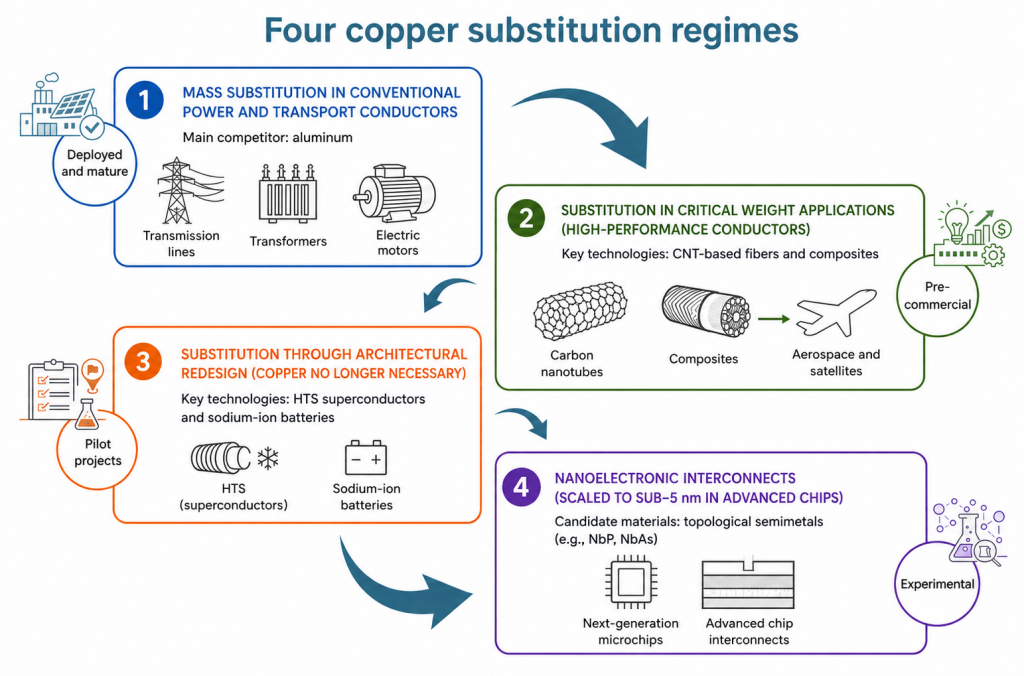
I am of the view that an honest evaluation should keep these regimes separate, since their technical, economic, and temporal limits can be quite different.
2. How much copper can actually be replaced?
The question looks simple: if we have substitutes such as aluminum, carbon fibers, copper-free batteries, and superconductors, how far can replacement go? Is it 5% of the copper we use today? 30%? Half?
The current state of copper substitution
The International Copper Association periodically publishes a survey in which it asks companies that use copper what percentage of their material is being replaced by other materials. The 2022 survey revealed that, each year, around 1.3% of annual copper consumption was being replaced by other materials, mainly aluminum. It is a small figure, but a stable one.5
Why is the transition away from copper so slow?
In many electrical applications, manufacturers have already invested in copper-based designs, qualification testing, installer training, terminals, connectors, and production machinery, so switching to aluminum is not just a change of material but an entire process of re-qualification and redesign. Aluminum can work well, but it often requires conductors of different dimensions, specific terminations, and meticulous control over oxide formation and joint reliability, which increases engineering and regulatory compliance costs. Economists would classify much of that investment as sunk cost, and the switch is usually only worthwhile when the copper price premium is large enough and persistent enough to justify the difficulties. That is why substitution can happen quickly in some segments and remain slow in others, even when copper prices rise.6
A 2025 econometric study by Soares et al.7 confirms this insight using data on global copper consumption between 1960 and 2019. The researchers found that consumers and manufacturers shift back to copper as the price of aluminum becomes more expensive. However, the magnitude of this effect is rather modest, and in practice, it means that even large swings in aluminum prices do not lead to a mass abandonment of copper. The technical barriers, certification costs, and performance trade-offs discussed above are what keep substitution slow and steady, regardless of price signals.
Projections for copper substitution
The specialized literature offers three reference points, separated both in time and in degree of optimism. Henckens and Worrell,8 in a conservative analysis aimed at European resource planning, estimated that only around 10% of the copper we use today has fully functional substitutes, mainly in non-electrical applications such as roofing, gutters, radiators, and water pipes, where plastics and aluminum already do the job with no significant losses in performance.
At the other extreme, Reijnders9 argued that we could reach 60% under the assumption of aggressive R&D progress and unconstrained availability of substitute materials: an optimistic hypothesis that would require carbon fibers, superconductors, and new battery chemistries to mature much faster than they have over the past decade.
And in between, the reference study by Graedel et al.10 projected 40%, counting any substitute whose performance is adequate or better, that is, accepting some loss of efficiency or a larger material volume in exchange for preserving the functionality.
This range between 10% and 60% reflects, indeed, the reality of the technical debate, but what really matters is that copper substitution is not distributed evenly across all applications. Aluminum, for instance, works wonderfully in high-voltage lines, but is not sufficient in electric motors, where the room available for windings is limited. Optical fibers have already replaced copper in telecommunications, but cannot be used to transmit power. And plastics solved the pipe problem decades ago. My question, then, is more specific: in which applications, at what pace, and at what cost can we replace copper?
3. Mass-scale substitution in conventional conductors
3.1 Aluminum: the substitute at scale
Aluminum is, as of today, the only substitute being deployed at a mass scale. Its fundamental limitations are dictated by physics: it exhibits a 61% IACS against copper’s 100%, a density equivalent to 30% of copper, and a specific heat capacity more than twice that of copper. As a result, to carry the same current, an aluminum cable requires roughly 1.6 times the cross-section of a copper cable. Table 1 summarizes the current state of copper-to-aluminum substitution in electrical and power applications, highlighting where it is in active substitution, where it is feasible only via redesign, and where it is not viable due to physicochemical constraints.
| Application | Status of aluminum | Key detail |
|---|---|---|
| Overhead transmission lines | ✅ Dominant | Near-total use (ACSR, ACSS, ACCC); copper was never the standard |
| Transformer and wind-turbine windings | ✅ Mature and widely used | Established technology, especially in large distribution transformers |
| Electric vehicle wiring harnesses | 🔄 Active substitution | AutoNetworks and Sumitomo Electric have developed aluminum-alloy conductors; BMW, together with TU München, has solved the historical aluminum creep problem by turning it into a self-stabilizing property through wedge-geometry contacts |
| Busbars in batteries and EV electronics | 🔄 Growing | Hybrid Cu-Al busbars are becoming increasingly common, thanks to new metallurgical joining processes |
| High-power-density motor windings | ⚠️ Limited / requires redesign | Higher DC losses; improves at high frequencies but requires geometric optimization |
| Current collectors in lithium batteries | ❌ Not viable | Chemical constraint: aluminum alloys with lithium at low potentials, destroying the collector |
| Solder joints and uncontrolled terminations | ⚠️ Problematic | Aluminum oxide is insulating. Today, this is solved with piercing crimp connectors and antioxidant compounds, but it requires training |
As Table 1 summarizes, there are several applications where aluminum already replaces copper or where it is being integrated, but I want to emphasize that it is well established that the energy intensity of primary aluminum production is 4–5 times higher than that of copper refining per ton. Any complete carbon footprint evaluation should take this into account. While it is true that this disadvantage can be partially offset by the reduction of the weight of the vehicle over its lifetime, that offset is neither automatic nor immediate.
In this context, the R&D frontier focuses on several promising lines: advanced alloys (Al-Mg-Si, Al-Zr, Al-Ce, Al-Fe), HTLS (high-temperature low-sag) conductors for grid reconductoring, and aluminum-graphene composites produced via shear-assisted extrusion (such as PNNL’s ShAPE process). The latter report conductivity improvements close to 7% relative to pure aluminum, along with a reduction in the temperature coefficient of resistance, sustained even in meter-scale wire. Nevertheless, the independent validation of these results is still pending and will be decisive for their future adoption.11
4. Substitution in critical applications
4.1 Carbon nanotube fibers
Carbon nanotubes (CNTs) start from a conceptually simple idea, but with extraordinary consequences. If we take a sheet of graphene (that is, a single layer of carbon atoms arranged in a hexagonal lattice) and roll it up on itself to form a cylinder just a few nanometers in diameter and ranging from microns to centimeters in length, we obtain a carbon nanotube.
An individual nanotube can reach exceptionally high electrical and thermal conductivities, as well as a mechanical strength far superior, in some cases, to that of many conventional materials. The fundamental challenge, however, is that these physicochemical properties are intrinsic to the behavior of a nearly perfect, isolated nanotube. In practice, this means that a cable used in the real world requires millions of nanotubes assembled, connected, and stabilized with one another. And that is precisely where the problem lies: a cable formed from millions of nanotubes loses, to a large extent, those extraordinary properties that CNTs possess at the nanoscale.
Distinguishing between individual and collective behavior has been one of the central axes of the field for years. Understanding that difference is essential in order not to confuse the promises of the laboratory with the reality of industrial products.
Why a nanotube fiber does not behave like a nanotube
When millions of nanotubes come together in a macroscopic fiber, electrons no longer travel along a single continuous channel; they have to cross a network of contacts between tubes, and each contact introduces additional resistance. The worse the alignment of the nanotubes, the shorter they are, and the greater the porosity or the proportion of voids between them, the higher the total resistance will be.
The conductivity of an individual nanotube is a property of the ideal material, while the conductivity of a nanotube fiber depends largely on its packing, its alignment, its densification, its doping, and the quality of its internal interfaces.
One of the most comprehensive recent reviews in this field, published in 2025 by Mikhalchan et al.,12 summarizes precisely this tension between the intrinsic potential of nanotubes and the actual performance of the assembled fiber material. In their work, the authors showed that carbon fibers with high alignment (FWHM ~7°) reached a conductivity of 2 × 10⁶ S/m, equivalent to roughly 3% of copper’s conductivity. This value appears to represent the theoretical ceiling for ideally structured assemblies of pristine CNT fibers. However, with the addition of acid dopants, the fiber conductivity rose to 11.2 × 10⁶ S/m, that is, 19% of copper’s conductivity. More impressive still, polymer doping achieved a conductivity equivalent to 98% of copper’s: in my opinion, a technologically remarkable achievement.
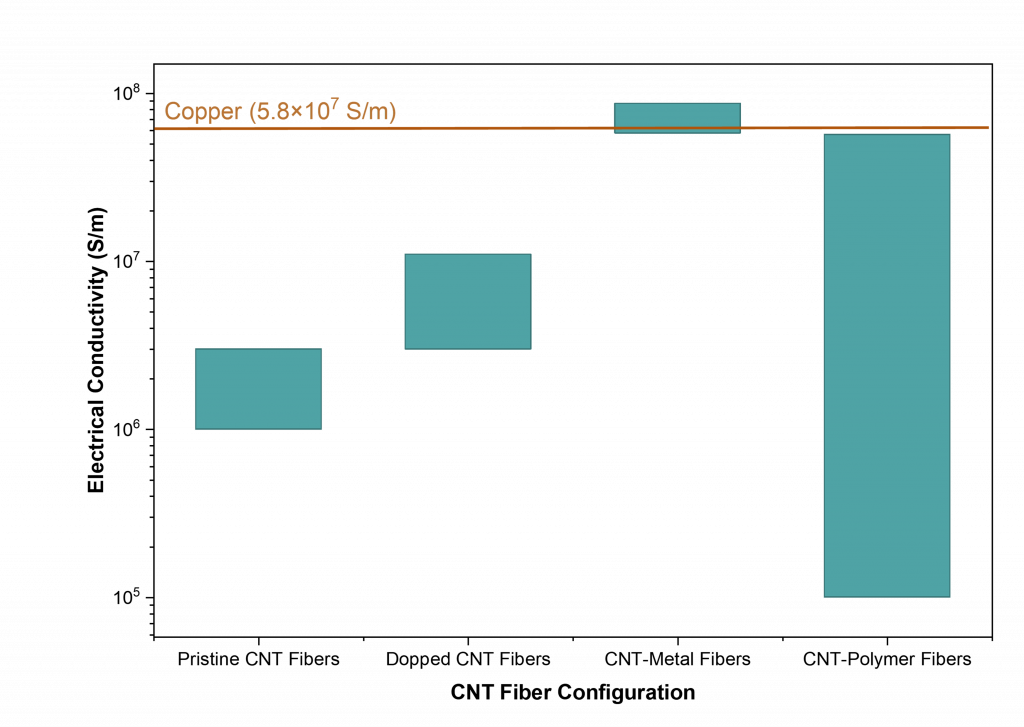
Copper and nanotubes together: the most promising line
Although strictly speaking, copper–CNT hybrids do not represent a strategy for replacing copper, they are worth mentioning in this article, since they rank among the best candidates for high-conductivity applications, with examples exceeding copper’s conductivity by more than 50%.13 These hybrid systems consist of a core or matrix of nanotubes acting as a mechanical scaffold, while copper provides the conductive pathway with a large effective cross-section. In other words, copper contributes the volumetric conductivity that pure CNT fibers cannot yet generally deliver; nanotubes, for their part, contribute to lightness, mechanical strength, and significant potential for material savings.
The industrial status of CNTs: from the lab to the factory
As enthusiastic and optimistic as I am about technological development, I am equally interested in looking honestly at what can really be translated from the laboratory to the industry: the most visible industrial translation of nanotube fibers does not run simply through replacing copper in power grids, but rather through applications where their lightness, strength, and chemical stability offer a direct advantage. And even so, serious barriers remain. Cost is still the first obstacle, with no economy of scale yet comparable to copper. On top of that, there is the interface problem: CNT fibers are porous materials, and reliably connecting them to terminals, soldered joints, or crimp connections remains a technical challenge, since a cable must not only conduct electricity but also make a proper connection. There is also the instability of doping: many of the best electrical results depend on dopants that degrade or migrate under humidity, temperature, or thermal cycling, compromising long-term reliability. However, real industrial applications are beginning to show interesting signals.
DexMat, for example, a Houston-based company that emerged from academic work at Rice tied to Matteo Pasquali, develops the Galvorn fiber through a wet-spinning process. The company claims its material reaches a tensile strength of around 3 GPa, a density of 1.6 g/cm³, and an electrical conductivity of up to 10 MS/m. It also reports that in 2025, it multiplied its volume-based revenue by 2.5 and has cut its costs by 96% since the pre-seed stage. In parallel, DexMat has signed a collaboration with Prysmian, one of the world’s leading cable manufacturers, to explore a new generation of high-voltage conductors based on Galvorn.
Separately, an academic demonstration of particular relevance is the one developed by the Korea Institute of Science and Technology (KIST), which in 2025 presented a fully metal-free electric motor. This device uses core-sheath conductors fabricated exclusively from CNTs via the LAST process (lyotropic liquid-crystal-assisted surface texturing).14 The prototype reached a specific rotational speed only 6% lower than that of an equivalent copper-based motor: a notable result for a first technological demonstration. However, the main drawback to its practical viability lies in production costs. While the CNT conductor (CSCEC) carries an estimated cost of USD 375–500/kg, conventional copper sits at around USD 10–11/kg.15 A cost ratio of roughly 40:1 is unlikely to be overcome by conventional learning curves within a one-decade horizon.
5. Substitution by architectural redesign
5.1 High-temperature superconductors
High-temperature superconductors (HTS) are materials that, below a critical temperature, enter a superconducting state with zero electrical resistance under direct current and appropriate conditions. The current 2G generation, based on REBCO (Rare-Earth Barium Copper Oxide) tapes such as YBCO (Yttrium barium copper oxide) or GdBCO (Gadolinium Barium Copper Oxide), typically operates with liquid nitrogen at around 65–77 K, far more accessible than the liquid-helium-based cryogenic systems that the classical superconductors required. The practical consequence is that in power applications, a single HTS cable can exceed 3 GW, and some industrial references put the current density of 2G REBCO tapes in liquid nitrogen at around 200 times that of conventional resistive cables.16
Today, the economics of HTS typically close mainly in specific applications, where power density, space, or weight compensate for the cost of cryogenics. High-density urban transmission is one such example: in cities, transmission lines are scarce and expensive, and AmpaCity in Essen has been demonstrating the operation of a 1-kilometer HTS link in a distribution network since 2014.17 There are also commercial solutions for urban data centers, and Airbus is developing Cryoprop, a 2 MW superconducting electric propulsion demonstrator for hydrogen aviation.18 Superconducting fault current limiters are already being deployed commercially, and the fusion has been an important driver of the renewed investment in REBCO/HTS since 2022.
The current Technology Readiness Levels (TRLs by ENTSO-E 2024) reflect the HTS field still halfway between demonstration and deployment, however the global HTS power cable market, estimated at ~USD 174 million in 2024, has a projection of already ~USD 578 million by 2032 (a Compound Annual Growth Rate, CAGR, of ~16%).
5.2 Sodium-ion batteries to eliminate copper
In a lithium-ion cell, the anode current collector has to be made of copper because aluminum alloys with lithium at low potentials. Sodium does not form that alloy, so in sodium-ion (SIB) and sodium-metal (SMB) batteries, both cathode and anode can use aluminum current collectors. The practical saving in the collector pair is around two-thirds of the cost compared to an equivalent Li-ion cell, with the added advantage that battery-grade aluminum is lighter and cheaper.
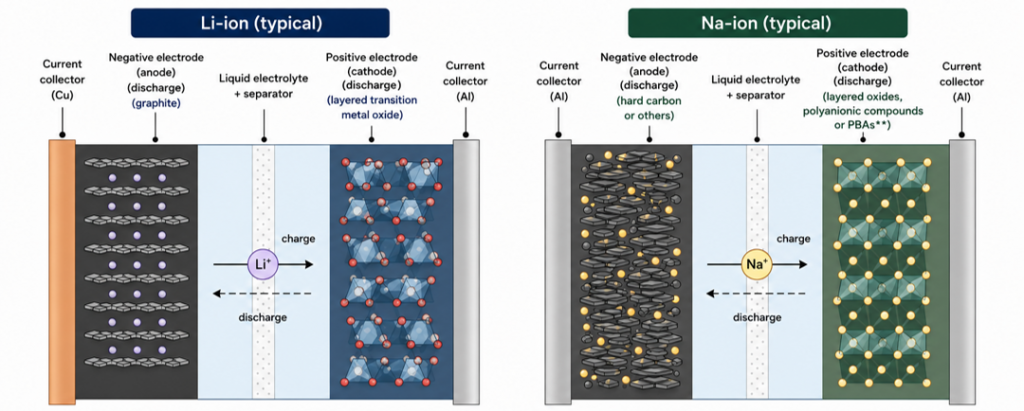
From the academic development point of view, a review in Energy & Environmental Science19 on electrolytes and interphases for anode-free sodium batteries highlighted the current collector architecture as a key strategy and identified the replacement of copper by aluminum at the anode collector as a broadly accepted design baseline for the system. In parallel, Tang, Yang et al.20 showed that a single-crystal aluminum collector obtained by high-temperature calcination enabled 500 cycles with 99.9% coulombic efficiency and symmetric cells stable for 2,500 hours under the given test condition. Other studies have also been published on porous or intermetallic aluminum collectors functionalized as sodiophilic hosts.
In 2025, industrial reality remained more complex. CATL, the Chinese world leader in EV batteries, launched the Naxtra and Freevoy models in April: Naxtra, its sodium-ion battery for mass production, offers a capacity of 175 Wh/kg, over 10,000 charge cycles, and a range of 500 km; while the Freevoy features a dual-energy-source architecture combining sodium and LFP. In parallel, Natron Energy ceased operations in September 2025 after failing to secure sufficient funding, showing that the commercialization of sodium-ion remains uncertain. From the cost point of view, the sodium-ion battery sector had not yet reached the maturity seen in lithium-ion technologies, although IRENA (International Renewable Energy Agency) noted that the costs could drop to around USD 40 per kWh at scale, though this does not guarantee widespread adoption.21
6. Nanoelectronic interconnects
6.1 Niobium phosphide: the semimetal for the next-generation chips?
NbP (niobium phosphide) is what is called a topological semimetal: a relatively new class of materials in which the electrons behave in a quantum-mechanically protected way, which lets them move along the material’s surface with almost no scattering. In a thick piece of NbP, this surface effect is negligible compared with what happens in the interior, and the material conducts worse than copper. But when the film is thin enough, the surface starts to dominate over the bulk, and something counterintuitive happens: the thinner the film, the better it conducts. Indeed, below 5 nm, NbP films outperform copper, reaching a conductivity of nearly 3 × 10⁶ S/m at just 1.5 nm of thickness. It’s worth noting that achieving this performance does not require a single-crystal structure, which makes fabrication considerably more realistic at an industrial scale.
A reader familiar with copper’s bulk conductivity (~5.8 × 10⁷ S/m) might reasonably object that NbP performs roughly twenty times worse. The objection is correct in absolute terms, but it misses the relevant comparison. At sub-5 nm thicknesses, copper no longer behaves like bulk copper: electron scattering at grain boundaries and surfaces becomes the dominant loss mechanism, and the copper resistivity rises sharply as the film gets thinner. Under those conditions, copper’s effective conductivity can collapse to the order of 10⁶ S/m, putting it below NbP at the same thickness.22
Why can structures at this level matter? Inside a modern processor, transistors are wired together through copper interconnects, and each new manufacturing node forces those wires to be narrower. At the dimensions I discussed above, the same scattering mechanisms that degrade the copper thin-films in the lab become the dominant constraint on chip performance: signals lose energy, heat accumulates, and the gains from shrinking transistors are partially eaten by the wires that connect them. This is the interconnect bottleneck, and it sets a hard ceiling on the scaling and energy efficiency of next-generation chips: precisely at the moment when AI deployment and data-center expansion are driving compute demand, power consumption, and internal bandwidth requirements sharply upward. In that context, an ultrathin NbP film is not only a replacement for copper across the chip, but also a candidate material for the finest interconnect layers, where copper physics breaks down. Note, moreover, that under the S&P Global 2026 projection, copper consumption from data centers alone would roughly double, from ~1.1 Mt in 2025 to ~2.5 Mt by 2040.1 If sub-5 nm interconnects force a partial material substitution at the most advanced nodes, both the demand curve and the supply chain for chip-grade conductors would look different from current projections suggest.
The NbP finding sharpens a broader question that runs through every section of this article: when we talk about replacing copper, what are we actually replacing, and what dependencies are we taking on in exchange? The answer determines whether the substitution narrative reduces structural risk or simply relocates it across the supply chain. The implications below develop two analytical consequences that follow from taking this distinction seriously.
Strategic Implications
The consensus accepts that copper substitutes exist and that they will scale; in my opinion, it misses that the substitution operates across four structurally distinct regimes with radically different timelines, costs, and chokepoints. The investment thesis that treats “copper alternatives” as a unified category, whether bullish on CNT startups or bearish on copper-intensive industrials, is modeling a system that still might not exist.
The aluminum regime has already run its course, where physics allows it.
Aluminum substitution is mature, ongoing at more than 1% annually, and bounded by hard physical and electrochemical constraints that I don’t see loosening on an investment-relevant horizon. The econometric evidence from Soares et al. confirms that the substitution elasticity is modest even under large price swings, because the barriers are mostly structural: sunk capital in tooling, qualification timelines, connector reliability, and oxide management. In my reading, the substitution ceiling is less about copper prices crossing some threshold and more about which applications can absorb the roughly 1.6× cross-section penalty aluminum carries.
The applications where I think aluminum simply cannot stand in for copper are precisely the ones driving demand from the electrification. High-power-density EV traction motors are the cleanest example: the binding constraint is volumetric power density and slot fill factor, and increasing the conductor cross-section by 1.6× inside a 400–800 V, 150+ kW motor means redesigning the motor around a larger, heavier package. Aluminum hairpin windings exist in lower-power 48 V systems, but Tesla, probably the OEM most aggressive on cost, still uses copper hairpins in its traction motors, and I read that as the revealed-preference signal. On the battery side, the constraint is electrochemical: aluminum alloys with lithium below ~0.3 V vs Li/Li⁺, which rules it out as the anode current collector. It works fine as the cathode current collector at higher potential, where it passivates, that mean that copper isn’t being replaced inside the cell in any meaningful sense. And the 10–60% substitution range in the literature reflects this segmentation, but in my opinion, portfolio positioning often conflates the two ends of that range. If I model a copper demand reduction from substitution, I am not gonna ask myself “how much copper can be replaced” in aggregate; I ask which slice has already been replaced in non-electrical applications, i.e. plumbing (largely done in new construction via PEX), automotive heat exchangers (partially done with aluminum), some HVAC, and whether the remaining electrical demand will move at all on a horizon that matters for capital allocation. Those are different questions with different answers, and conflating them produces the wrong demand curve.
For European procurement and grid reconductoring, I’d separate two things that often get bundled. HTLS aluminum conductors (ACSS, ACCC, ACCR) are not really a frontier technology nowadays: CTC Global’s ACCC is already deployed at scale in the US and increasingly in Europe, and the real bottleneck for European reconductoring is mostly permitting and deployment pace, not the conductor itself. The actual R&D frontier sits with aluminum-graphene composites: the PNNL’s ShAPE process has demonstrated a roughly 7% increase in conductivity compared to pure aluminum in 1-meter-long cables, with financial support from Norsk Hydro and the emergence of independent academic research on AA3003 and graphene systems. What I’d still want to see is cost at scale, long-term reliability under thermal cycling, and drawability into fine-gauge wire.
One nuance I think gets under-weighted: the same ShAPE process is producing copper-graphene composites with ~5% conductivity gain and an 11% TCR reduction, and GM has tested that wire for motor applications. If copper-graphene matures on a similar timeline, the case for swapping motor windings to aluminum-anything weakens further, because the volumetric-conductivity advantage of copper just gets larger. So in my opinion, the most honest framing is: aluminum substitution is essentially complete where physics allows, and structurally capped where power density or electrochemistry binds.
What would change my view: large-scale qualification of sub-USD 15/kg aluminum-CNT composites with validated conductivity above 70-80% IACS (meaningfully above pure aluminum’s ~61% IACS baseline, which is the real bar), combined with stable crimping interfaces that survive thermal cycling. That combination would reopen the motor-winding pathway, and the crimp/termination problem is the silent failure mode most coverage skips. Without that breakthrough, aluminum is not the lever I would model to relieve copper tightness in electrification.
Carbon nanotube economics do not close outside aerospace and defense within a decade.
The KIST metal-free motor (Ryu et al. 2025) is a genuine technical milestone, but in my reading, the headline number “near-parity with copper” can be over-reported. The CNT cable itself reached 7.7 MS/m, roughly 13% of copper’s volumetric conductivity. The motor ran at 3,420 RPM at 3 V against 18,120 RPM for the copper equivalent, so on absolute electrical performance, it’s about 5× slower. The actual milestone is weight-normalized: the specific rotational velocity was only ~1.06× lower than copper-based motors, because CNTs are less dense than copper. This distinction highlights applications where weight is a critical factor (drones, the aerospace industry, CubeSats) but says very little about applications with volume constraints, such as power lines or stationary motors.
The cost ratio reinforces the segmentation. Industrial-grade Multi-Walled CNT powder sits at roughly USD 150–600/kg, Single-Walled CNT conductor-grade fiber materials at USD 400–1,000+/kg (DexMat’s Galvorn, Tortech, AIST core-shell systems), against the copper wire rod at ~USD 12–15/kg in 2026. We are talking about a cost ratio of roughly 20–80×, depending on which CNT format is selected. I think the carbon-fiber learning curve is the right analogy here: PAN-based carbon fiber has dropped from ~USD 200/kg in the 1970s to ~USD 20–30/kg industrial grade today, roughly 7–10× over five decades, but it never achieved a cost parity with its incumbent comparator (glass fiber, steel). Where it won was in weight-critical applications where the performance premium justified the price. That’s the same pattern I would expect for CNT conductors through 2035: aerospace wiring, defense systems, premium-segment EV harnesses where every kilogram saved is worth the cost.
DexMat’s revenue growth and the Prysmian partnership signal a commercial momentum, but on a small base and not on a gigawatt-hour scale production. Galvorn’s datasheet shows 10 MS/m volumetric conductivity against 58 MS/m of copper, but on a per-mass basis, the two materials are nearly equivalent (6,150 for Galvorn vs 6,300 Sm²/kg for copper). Further, research-stage results going further (polymer-doped CNT fibers approaching ~98% IACS) exist, but dopant stability under humidity and thermal cycling is not, in my view, validated for grid-scale use. The Mikhalchan et al. review makes the right diagnosis: inter-tube contact resistance, not intrinsic CNT conductivity, is the dominant loss mechanism in macroscopic fibers: a process problem more than a materials problem, and wet-spinning and LAST remain batch or semi-continuous.
The Cu-CNT hybrid pathway (specific conductivity over 150% of pure copper in some demonstrations) is more industrially plausible because it leverages copper’s conductivity while using CNTs for mechanical reinforcement and weight reduction. But in my opinion, the deeper point is one of supply-chain framing: Cu-CNT is copper enhancement, not copper substitution. It increases the value-added per kilogram of copper while still depending on refined copper feedstock, and for a portfolio thesis, that means it raises copper’s effective utility per ton rather than reducing demand for it. Anyone modeling Cu-CNT adoption as a copper-demand-reduction story is, I think, reading the chemistry backwards.
What would change my view: a validated continuous CVD (chemical vapor deposition) or solution-spinning process for CNT conductors achieving >5 kt/year nameplate capacity at a price lower than USD 50/kg all-in cost, with documented dopant stability under thermal cycling and humid environments. That benchmark would put CNT conductors at roughly 3× copper rather than 20–80×, and at scales relevant to grid procurement. Lower oil prices would help at the margin via precursor costs, but the leverage is, in my opinion, modest (oil → acrylonitrile → PAN → CF is roughly a 20% cost lever, and CNT precursors are even further removed from crude). Unless there is a significant improvement in costs of scale, I expect carbon nanotube conductors to remain a niche product through 2035, and I do not anticipate that demand for copper in motors, wiring harnesses, and power grid cables will be significantly affected by this development.
Superconductors and sodium-ion batteries relocate copper dependency rather than removing it.
HTS cables eliminate copper per unit of transmitted power, which is analytically distinct from eliminating copper demand in aggregate. The AmpaCity link in Essen — a 1 km medium-voltage cable that replaced a conventional copper line in the city’s distribution grid — is the reference case. It uses a cuprate ceramic tape (so the conductor itself contains copper, in grams per km rather than tons), continuous liquid-nitrogen cooling, and carries roughly two orders of magnitude more current density than resistive copper. Capital cost runs about twice that of a copper cable per km, but the real economic argument isn’t the per-km comparison — it’s that an urban network of 20 transformers can be reduced to 15 with HTS.
The HTS cable market projections vary wildly between forecasters, which itself signals how thin the actual deployment base is. Against that, data centers alone are projected to add over a megaton of new copper demand by 2040 (S&P Global, 2026). Fusion, aviation, and fault-current limiters are high-value HTS deployments, but in my view, they don’t move the global copper balance. The relevant insight is that HTS is a substitution by system redesign, viable in ultra-high-density corridors and weight-critical applications like Airbus Cryoprop, but not a scalable replacement for resistive copper in distributed grids, building wiring, or vehicle harnesses. And the real copper relocation in HTS systems sits in the cryogenic plant (compressors, heat exchangers, pumps), and the conventional cable runs between HTS segments… both copper-intensive.
Sodium-ion batteries present a parallel case. Replacing copper current collectors with aluminum at the anode saves roughly two-thirds of current-collector cost and removes the lithium-alloying constraint that makes copper chemically necessary on the anode side of Li-ion cells. CATL’s Naxtra (175 Wh/kg, 10,000 cycles, 500 km range claim) and the dual-chemistry Freevoy are commercially deployed, and academic work on anode-free sodium cells with single-crystal aluminum collectors reports 500-cycle stability and 99.9% coulombic efficiency under controlled lab conditions. Natron Energy’s September 2025 shutdown after failing to secure funding is a useful counterweight — though I think the lesson is more specific than “commercial viability isn’t guaranteed by technical feasibility.” Natron ran on Prussian-blue chemistry (lower energy density, harder to scale) rather than CATL’s layered-oxide approach, and its failure also coincided with a 70–90% lithium price collapse that closed SIB’s cost advantage against LFP. The deeper takeaway, in my view: SIB’s economic window narrows when lithium stays cheap, and the financial fragility of Western battery manufacturers (Northvolt, Powin, Natron in quick succession) means the SIB scale-up will almost certainly be Chinese-led regardless of where the chemistry itself goes.
So, if SIB reaches IRENA’s projected USD 40/kWh at scale (currently an aspirational figure, with SIB cells at roughly USD 70–90/kWh in 2026 against LFP at USD 55–70/kWh) and captures 15–25% of the stationary storage and low-range EV markets by 2035, it removes copper from the current-collector bill of materials in that segment… It does not remove copper from the battery pack’s busbars, module interconnects, or the DC-AC conversion and grid-coupling infrastructure that every storage system requires. The substitution is partial, segment-specific, and gated by SIB cost competitiveness against LFP… which has its own learning curve.
What would change this: SIB production costs reaching USD 50/kWh with validated 15-year cycle life in field deployments, and not only lab cells. That would meaningfully accelerate copper displacement in stationary storage. Conversely, if CATL’s Shenxing LFP platform sustains <USD 60/kWh with 4C charging at scale, SIB’s addressable market would shrink, and copper substitution in batteries would likely remain negligible.
The semiconductor interconnect pathway is the only one that structurally decouples a high-value application from bulk copper supply, and it runs through niobium, not carbon.
NbP’s resistivity at 1.5 nm thickness is roughly 20× lower than bulk copper, but at the same sub-5 nm thickness, it outperforms copper, whose grain-boundary and surface scattering collapse its effective conductivity into the same order of magnitude as NbP. The mechanism is what makes this strategically different from prior interconnect-material candidates: NbP is a topological semimetal, and its surface states carry an increasing share of the current as the film thins, so the conductivity improves with thinning, exactly opposite to copper’s behavior. This is the interconnect bottleneck limiting transistor scaling, and as nodes shrink toward 2 nm and below, copper interconnects become the dominant source of resistive loss, heat generation, and signal delay. The film is also deposited at 400 °C, which sits within the thermal budget for back-end-of-line integration, a non-trivial point, because most exotic-material candidates fail BEOL qualification on temperature ceilings alone.
The strategic consequence is that if NbP or a comparable topological semimetal (NbAs, other Weyl/Dirac candidates) qualifies for BEOL metallization at sub-3 nm nodes by 2028–2030, it does not compete with copper on price per kilogram, but it competes on chip performance per watt and transistor density per mm². And the semiconductor industry will pay a materials premium for a conductor that enables continued Moore’s Law scaling when copper cannot. S&P Global’s January 2026 report projects data-center copper demand from 1.1 Mt (2025) to 2.5 Mt (2040), but that projection assumes copper interconnects remain viable at advanced nodes. If TSMC, Samsung, or Intel transition to NbP-based interconnects at N2 or N1.4, copper intensity per wafer drops, and total copper demand from leading-edge fabs plateaus rather than doubling. In my reading, this is the only substitution regime in the article where the material science, the economics, and the deployment timeline align to structurally reduce copper dependency in a high-growth, high-value application within a decade.
Niobium is not a bulk commodity: the global production is ~80 kt/year, with ~75% from CBMM in Brazil and the remainder largely from Niobec in Canada, but chip-grade NbP consumption, even at full N2/N1 adoption, would be measured in hundreds of tons annually rather than kilotons, because interconnect layers are nanometers thick. The supply-chain chokepoint isn’t than niobium mining, but more likely high-purity phosphorus precursors, thin-film deposition equipment qualification, and the integration of a non-copper conductor into BEOL processes that have been copper-optimized for 25 years.
I would monitor two signal sources for non-copper metallization pilots: major foundries (Samsung, TSMC, Intel) for production-pathway commitments, and earlier-stage start-ups for the leading indicators that usually appear 12–18 months before foundries disclose. If NbP or competing semimetals appear in back-end interconnect layers at N2, the implication is that the semiconductor industry has decoupled its performance roadmap from copper availability. That does not crash copper prices, since chip-level copper is 2–3% of global demand, and NbP substitution doesn’t touch the surrounding fab infrastructure, cooling, or power delivery (which is most of the data-center copper footprint). But it removes the specific feedback loop where AI compute scaling drives chip demand, chip demand drives copper intensity per wafer, and copper shortages constrain compute deployment. That feedback loop is, in my view, the single most underpriced supply-chain risk in the AI capex cycle, and NbP is the most credible technical exit from it.
What would change my view: copper resistivity recovering at sub-5 nm through grain-boundary engineering, for example, graphene-passivated copper interfaces sustaining bulk-like conductivity below 3 nm (IBM, IMEC, and MIT groups are working on this, but no demonstration at a production-relevant scale). If that pathway works, NbP remains a research curiosity, and the semiconductor-copper dependency persists.
References
- S&P Global (2026). Copper in the Age of AI: Challenges of Electrification.
- Simon, Adam C.; Cathles, Lawrence M.; Wood, Dan (2026), The widening gap between copper supply and demand will have an impact on economic development and energy futures, Energy Research & Social Science, vol. 133, art. 104581, 2026. doi: 10.1016/j.erss.2026.104581
- Khanbolouki, P., et al. (2025). Insights into Graphene-Copper Conductors: Evaluating Conductivity Enhancement and Measurement Challenges. ACS Applied Electronic Materials, 7(9), 3775–3785. doi: 10.1021/acsaelm.5c00047.
- Wang, J., et al. (2024). Investigation on the Novel High-performance Copper/Graphene Composite Conductor for High Power Density Motor. CES Transactions on Electrical Machines and Systems, 8(1), 80. doi: 10.30941/CESTEMS.2024.00009.
- DMM Advisory Group, Copper Substitution Survey 2022. International Copper Association. [PDF].
- International Copper Association – Substitution Category.
- Soares, A.F. et al. (2025). Projection of global copper demand in the context of energy transition, Resources Policy, 103, 105567. doi: 10.1016/j.resourpol.2025.105567
- Henckens, M.L.C.M. y Worrell, E. (2020). Reviewing the availability of copper and nickel for future generations. The balance between production growth, sustainability, and recycling rates. Journal of Cleaner Production, 264, 121460. doi: 10.1016/j.jclepro.2020.121460.
- Reijnders, L. (2021). Copper substitutability might be about 60% or more of current copper use. Journal of Cleaner Production, 280(2), 125014. doi: 10.1016/j.jclepro.2020.124774.
- Graedel, T.E., Harper, E.M., Nassar, N.T. y Reck, B.K. (2015). On the materials basis of modern society. Proceedings of the National Academy of Sciences, 112(20), 6295–6300. doi: 10.1073/pnas.1312752110.
- Idaho National Laboratory (2023, revised 2024). Advanced Conductor Scan Report. [PDF].
- Jo, S., Mikhalchan, A., Hong, S. et al. (2025). Highly conductive hybrid carbon nanotube fibers: Strategies and future directions for replacing copper with next-generation conductors. Composites Part B: Engineering, 300, 112471. doi: 10.1016/j.compositesb.2025.112471
- Sundaram, R.M., et al. (2023). Single-Walled Carbon Nanotube/Copper Core-Shell Fibers. ACS Nano. doi: 10.1021/acsnano.3c00488
- Ryu, KH., et al. (2025). Core-sheath composite electric cables with highly conductive self-assembled carbon nanotube wires and flexible macroscale insulating polymers for lightweight, metal-free motors. Adv Compos Hybrid Mater 8, 230. doi: 10.1007/s42114-025-01302-4
- Salas, J. (2025) Radical electric motor runs without metal coils. New Atlas.
- Yazdani-Asrami, M. et al. (2022). High temperature superconducting cables and their performance against short circuit faults. Superconductor Science and Technology, 35, 083002. doi: 10.1088/1361-6668/ac7ae2.
- Nexans. AmpaCity: optimizing the German city grid.
- Airbus Press Release (2024). Airbus takes superconductivity research for hydrogen-powered aircraft a step further.
- Li, H. et al (2025). Anode-free sodium metal batteries: optimisation of electrolytes and interphases. Energy Environ. Sci.,18, 3887. doi: 10.1039/D5EE00136F
- Tang, F., et al. (2025). Initially, an anode-free sodium metal battery enabled by a strain-engineered single-crystal aluminum substrate with (100)-preferred orientation. Nature Communications, 16, 2280. doi: 10.1038/s41467-025-57424-2
- IRENA (2025). Sodium-ion batteries: a technology brief. [PDF]
- Khan, A.I., et al. (2025). Surface conduction and reduced electrical resistivity in ultrathin noncrystalline NbP semimetal. Science, 387, 62–67. doi: 10.1126/science.adq7096