
Table of Content
Table of Contents
Electrochemical Storage: Introduction
Earlier this year, the director of APPA Renovables confirmed that Spain wasted 17% of its renewable electricity generation,1 a notable increase compared with the 8% recorded in 2024. In addition, the cost of resolving technical restrictions in 2025 has been estimated at no less than €3.77 billion, 49% more than the previous year.2 I use the Spanish example because it is the European country with the largest solar resource, with a target of more than 80% renewable electricity by 2030 and a battery project pipeline of 38 GW, of which 16 GW already hold transmission grid access permits.3 Bear in mind that at the end of 2025 there were barely 96 MW of operational battery storage on the grid,4 0.4% of the capacity planned for 2030. Outside Spain, battery storage is approaching 270 GW,5 with China leading at 145 GW.6
Given the intermittency and low energy density of renewable sources, it is clear that some form of energy backup is required and, in this context, battery storage emerges as one of the most direct and natural solutions.
This article focuses on battery storage: how far the technology has come and which challenges remain in an increasingly electrified system.
1. Lithium-ion batteries
The two chemistries that today dominate stationary storage are NMC (nickel-manganese-cobalt) and LFP (lithium-iron-phosphate) batteries. These technologies share the same rocking-chair architecture, that is, Li⁺ ions intercalate reversibly between cathode and anode, but they differ in voltage, energy density, safety, cost, and service life.7 Modern technologies such as NMC-811 batteries (80% Ni, 10% Mn, 10% Co) operate between 3.6 and 4.3 V with energy densities of 200–260 Wh/kg. LFP, on the other hand, with the reaction LiFePO₄ ⇌ FePO₄ + Li⁺ + e⁻, operates at a flat voltage of approximately 3.45 V and lower densities in the range of 90–205 Wh/kg.8,9
If energy density were the only criterion, NMC would win. But for grid-connected stationary storage, energy density takes a secondary role: space is abundant, cost per kWh rules, and what matters is cyclability, raw materials, and thermal stability. On these three fronts, LFP technology is superior:10
- Its typical service life is 2,000 to 5,000 cycles, compared with 1,000–2,300 for NMC;
- It does not require critical materials such as cobalt and nickel for its manufacture, and
- It consists of an olivine-type structure that does not release oxygen when overcharged, which makes it intrinsically more resistant to thermal runaway.
I want to highlight, however, that LFP uses more copper and graphite per kWh stored than NMC: that is, the technological displacement does not eliminate material dependencies, but rather redistributes them. For a deep dive into the current copper landscape, readers can explore the Copper review article and the Copper Substitutes deep dive.
The rise of LFP in stationary storage has been exceptionally rapid, both in scale and geographic reach. According to InfoLink,11 global energy storage cell shipments reached 612.39 GWh in 2025, of which 556.74 GWh went to utility-scale systems. In addition, BloombergNEF projections point to a near-total displacement of NMC in this segment, with a share close to 1% by 2030.10 What is also changing just as rapidly is the regional distribution: shipments outside China reached 299.79 GWh in 2025, approximately 49% of the global total, and exceeded the 50% threshold in the second half of the year (51.3%). In other words, the center of gravity is no longer exclusively Chinese: although LFP remains a China-driven technology, its deployment is becoming structurally global.11
At the same time, the cost curve has continued to fall significantly: average lithium-ion battery pack prices dropped 20% in 2025 to $115/kWh (the largest decline since 2017), while complete stationary systems were priced at around $140/kWh, with cells below $78/kWh.12 Spain already has assets operating in this regime: Iberdrola’s twin plants at Romeral and Olmedilla (Cuenca) total 60 MW / 120 MWh and entered service in January 2026.13 They are the country’s largest stand-alone BESS installation, although they remain smaller than a medium-sized project in Texas.
This is the technology that dominates current deployment. I prefer to recognize first what it has achieved in cost, scale, and reliability before analyzing where its limits begin.
2. Round-trip efficiency: a systemic tax
Each time a battery stores and returns energy, a fraction is lost in the process. At system level, that is, including inverter, transformer, and power electronics, the round-trip efficiency (RTE) of a modern lithium cell is around 82–90%; with 85% being the value used as a reference by the National Renewable Energy Laboratory.14 In other technologies, which we will analyze later, these losses can be more pronounced: vanadium flow batteries typically range from 65–80% at system level, while iron-air batteries can drop to 40–50%.15
This figure, often treated as a secondary technical parameter, has systemic implications that rarely appear in commercial brochures.
If we want to deliver 1 MWh to the system, a battery with an RTE of 85% needs approximately 1.18 MWh of input energy; with an RTE of 65%, around 1.54 MWh; and with 45%, close to 2.22 MWh.
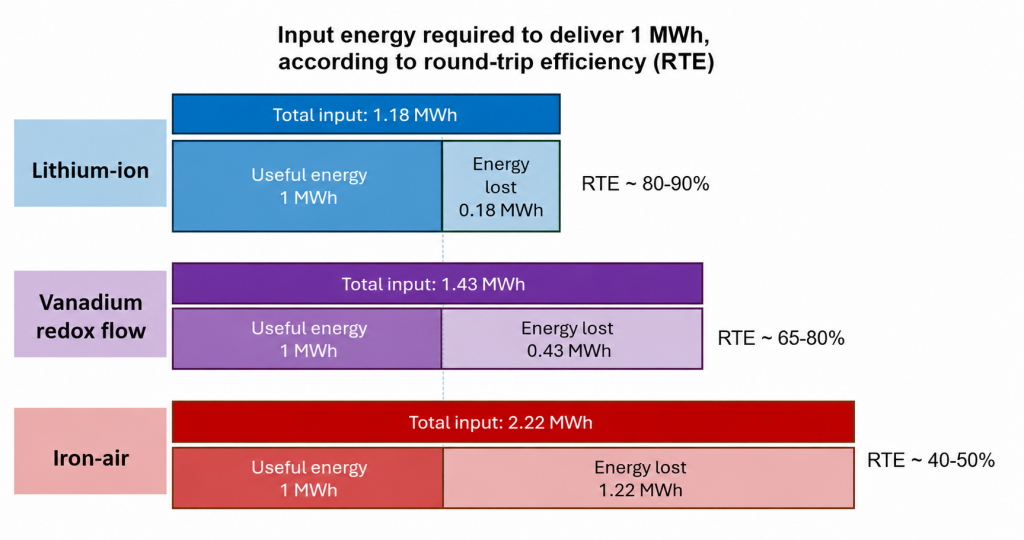
That additional energy does not come from nowhere: it must be generated, normally through more installed renewable capacity, evacuated through more electrical infrastructure, and managed within the system. In physical terms, this translates into a structural oversizing of generation and grid (more steel, more copper, more concrete) that the system ends up paying for in costs, materials, and time. A practical example always helps in understanding these concepts. Imagine a system of 100 GW of iron-air batteries operating on weekly cycles in Europe. With an RTE of around 45%, more than half of the energy is lost in the cycle. To deliver the same useful energy as an equivalent system based on lithium-ion with ~85% RTE, on the order of 50 GW of additional renewable generation would be needed just to compensate for those losses. This is a figure comparable to all the solar capacity installed today in Spain: we are no longer talking about a technical detail, but about system scale. This does not invalidate iron-air, since there are contexts where its low cost per kWh stored compensates for the inefficiency, especially when the alternative is renewable curtailment, which we will see later, but it does put efficiency in perspective: it is not a secondary parameter of the battery itself, but rather a design variable for the entire system.
When, for example, Form Energy announces costs of ~$20/kWh for 100 hours of storage, the figure is technically correct at the device level, but the relevant cost for the system must include the oversizing of generation, grid, and management capacity that the battery’s efficiency imposes. This point has been formalized by Paul Albertus and colleagues in Joule: for long-duration storage (LDES), the appropriate metric is not LCOS (levelized cost of storage, the corresponding LCOE for storage technologies) in isolation, but rather the marginal cost of the system, which integrates generation, transmission, and the interaction between storage technologies of different durations.16
3. The duration challenge: 2 hours for a spectrum that ranges from 2 to 500
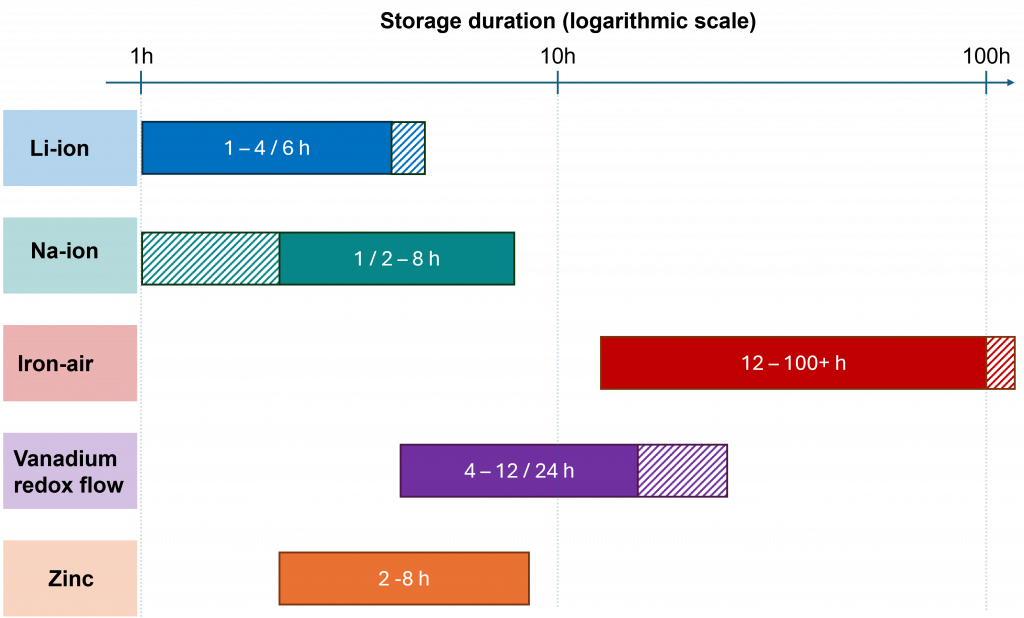
The average duration of batteries installed on the global grid is approximately 2 hours, dominated by lithium-ion technology. According to Wood Mackenzie, long-duration energy storage technologies (LDES, with more than 4 hours) accounted for only 6% of global storage installations in 2025, despite 49% growth in deployment to surpass 15 GWh.17 This profile reflects the economic optimization of Li-ion for frequency services, daily arbitrage, and evening solar peak shifting, where revenue windows are limited to a few hours.
Support Independent Analysis
This entire article is free to read. Producing this level of analysis requires many hours of reviewing scientific literature, industry reports, and primary datasets to build a coherent picture. If you value independent, evidence-driven research, consider supporting it with a Pro membership.
However, the profile of the problem varies with renewable penetration. With 10% solar PV, 2 hours of storage are enough to shift the daytime peak. But with 40% (as in Spain during sunny springs), those 2 hours only capture the sharpest peak, curtailing the rest of the surplus generation. In net zero scenarios where solar + wind exceed 70% of annual energy generation, the problem changes qualitatively: it is no longer about flattening daily peaks but about managing multi-day weather variations (European Dunkelflaute, cloudy Iberian weeks, wind-poor winters) and, eventually, seasonal variations. The greatest challenge in implementing LDES technologies is not having a chemistry that works (in the next section, we will see the best candidates), but rather making that chemistry economically competitive with the alternatives. The article published in Nature Energy by Sepulveda and colleagues modeled fully decarbonized power systems to identify the price point at which LDES begins to provide real value to the system.18 The results showed that for LDES to reduce the total cost of the electricity system by at least 10%, i.e., to be worth deploying at scale as a complement, the energy capacity cost would need to fall to $20/kWh or less. It is demanding, but not impossible: iron-air batteries under development are aiming precisely at that threshold. However, for LDES to fully replace firm low-carbon generation, i.e., to dispense with backup nuclear, gas, or biomass, the cost would have to fall to $1/kWh. The authors themselves acknowledge this second threshold as “unlikely to be reached with known LDES technologies” in high-latitude systems with full electrification of end use.
That is, even in the most optimistic cost scenario, in decarbonized systems, LDES probably has to coexist with a firm backup generation source.
In a more recent work by Staadecker et al.,19 the authors modeled the U.S. western power system (Western Interconnect, covering eleven states with parallels to the European transition) under 39 zero-emissions decarbonization scenarios. The results indicated that the value of LDES depends on factors such as generation mix (solar vs. wind), hydroelectric availability, transmission expansion, storage costs, and regulatory mandates. These scenarios generate value ranges with little overlap, highlighting that LDES is key in wind regions or those with declining hydroelectric capacity, and that mandates of up to 20 TWh would reduce peak prices by less than 70% and curtailment by 92%.
4. The three storage technology candidates for the multi-day gap
There are three serious electrochemical candidates for durations of 8–100+ hours, plus pumped hydro, which serves as a historical reference: vanadium redox flow batteries, iron-air batteries, and zinc batteries. This is perhaps the most technical part of the article, and I prefer to warn the reader in advance: I will try to maintain a balance between rigor and clarity, but inevitably, we are going to get a little into the chemistry.
Vanadium redox flow batteries (VRFB)
Conceptually, I find vanadium redox flow batteries (VRFB) and elegant chemistry:20 they store energy in two tanks of liquid electrolytes (V²⁺/V³⁺ in the anolyte and VO²⁺/VO₂⁺ in the catholyte), pumped through a cell with an ion-exchange membrane. This independent separation between power (size of the cell/stack) and energy (volume of tanks) enables flexible scalability for long-duration storage, and the use of the same element (vanadium) on both sides minimizes permanent contamination from membrane crossover, causing only temporary correctable imbalances. Among its technical advantages, its exceptional service life stands out: >20,000 cycles with minimal degradation (<1% per cycle under optimal conditions), thanks to redox stability and the absence of structural degradation, along with its recyclability: vanadium retains approximately 95% of its residual value at the system’s end of life, allowing reuse of the electrolyte.
The challenges are in fact economic rather than technical, as I mentioned earlier. The electrolyte represents 30–50% of the total cost of the VRFB system, driven by the price volatility of vanadium pentoxide (~$5.5/lb in 2024, after falling from $7.5/lb in 2023).21 On the other hand, 67% of the world’s vanadium production is concentrated in China, which adds a geopolitical dimension. WoodMac projects that VRFB cost will fall by more than 30% by 2034, but will still be ~240% higher than 4-hour LFP. However, global VRFB deployment crossed the GWh barrier for the first time in 2024, almost exclusively through Chinese projects, the largest being Jimusar (200 MW / 1 GWh), which entered service in July 2025. Outside China, total deployed capacity continues to be measured in hundreds of MWh.22
Iron-air batteries
Thermodynamically, iron-air batteries are among the most attractive options for long-duration storage. Iron is abundant, cheap, and largely free of geopolitical supply restrictions, while the electrochemical reactions are conceptually simple: metallic iron is oxidized during discharge (e.g., Fe + 2OH⁻ → Fe(OH)₂ + 2e⁻) and reduced during charge, while the air electrode catalyzes oxygen reduction and evolution. The theoretical specific energy of the iron active material is around 764 Wh/kg, although in practice, cell energy is significantly lower because the complete system includes electrolyte, air electrode, and structural components.23
The main bottlenecks of these technologies are rather electrochemical and well documented:24
- The reversible oxygen reduction and evolution reactions at the air electrode are kinetically slow and contribute significant overpotentials, although the exact values, often of several hundred millivolts, depend strongly on the catalyst, electrolyte, and current density.
- Hydrogen evolution can compete with iron deposition during charging, especially in alkaline electrolytes, because the hydrogen evolution reaction and iron reduction occur at close potentials; this competition degrades round-trip efficiency and can reduce cycle life.
- Added to this, iron-based discharge products can form resistive or passivating films (such as Fe(OH)₂, FeOOH, Fe₃O₄, and related oxides/hydroxides) that limit utilization of the active material and may abruptly end discharge after deep cycling.
The changes of the past 18 months have raised the profile of iron-air batteries. Form Energy, a U.S. startup that has raised more than $1.2 billion, began deployment of its first commercial iron-air installations in 2025 and has since been scaling toward grid-connected operations, with a focus on multi-day storage applications: the so-called “100 hours.”25 In Europe, a small but significant milestone is the 4.2 MWh iron-air pilot from Ore Energy, which in mid-2025 became the first grid-connected iron-air battery in the Netherlands, at the Green Village test site of TU Delft. Beyond this demonstration, several developers are preparing larger-scale projects, such as a 10 MW / 1 GWh iron-air system in County Donegal, Ireland, proposed as the first multi-day storage installation of ≈100 hours in Europe.26
Zinc batteries (zinc-air, zinc-bromine, zinc-ion)
These technologies form a family that shares a series of common challenges. Recharging tends to promote the formation of Zn dendrites, structurally more problematic than in the case of iron; changes in electrode shape (non-uniform redistribution of material) further limit cycle life and active-material utilization. In zinc-bromine systems, the volatility, toxicity, and corrosivity of bromine require the use of complexing agents and careful cell design, which adds costs and safety burden. The bankruptcy in late 2024 of Redflow, a pioneering zinc-bromine battery manufacturer, underscores the commercial and technical obstacles these systems have faced. At the same time, aqueous zinc-ion batteries are attracting a renewed wave of investment, in part because they share materials and supply-chain synergies with sodium-ion technologies and are perceived as safer and more sustainable. It remains to be seen which of the zinc-based configurations will scale most successfully; the family as a whole will be tested over the next 3–5 years, with several European R&D and demonstration projects now advancing zinc-air and zinc-ion concepts for stationary storage.27
Reversible pumped hydro
It is not electrochemical, but I add it to the list since it is an essential quantitative reference. With ~189 GW installed globally and around 9,000 GWh of stored energy, it represents nearly 94% of global energy storage.28 It played a critical role in the recovery following the Iberian blackout of 28 April 2025. However, its construction timelines (10–15 years) and geographic requirements prevent it from covering the short-term gap, but on a 2050 horizon it remains the mature technology with the best LCOS for multi-day durations. Spain’s 6 GW of pumped hydro are, in terms of stored energy, the country’s largest reserve of flexibility by a wide margin.
5. The “in five years, for a decade” pattern over four decades
LDES are not novel technologies, they have been discussed for decades as a potential complement, or even a successor, to lithium-ion batteries, and yet they have not achieved broad and economically viable deployment at scale. Most LDES concepts remain in the pilot, demonstration, or early commercialization phase, trying to close the gap in cost, reliability, and supply-chain maturity that lithium-ion has already solved.
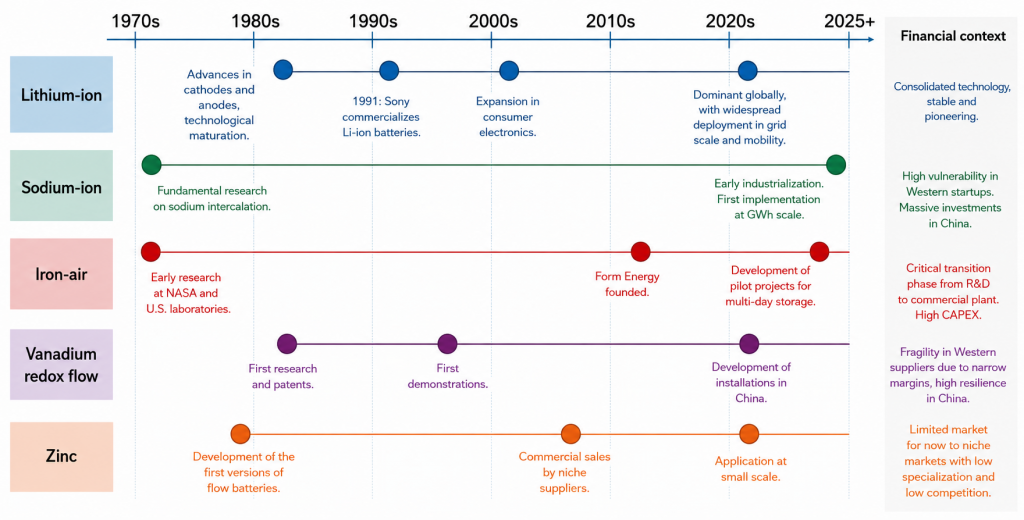
Vanadium redox flow batteries (VRFB), for example, were licensed and developed toward commercialization in the mid-1990s, with early work supported by institutions such as the European Community and, later, by national laboratories and utilities. Four decades later, VRFB deployment outside China remains limited to relatively small projects and niche applications; the cumulative installed capacity in the rest of the world is better measured in tens or a few hundred MWh, not on the gigawatt-hour scale of lithium-ion, as already noted earlier. In the U.S. flow battery sector, Eos Energy has accumulated net losses of around $1.9 billion in recent years, reflecting the difficulty of scaling manufacturing and reaching profitability in a capital-intensive, high-cost technology.29 ESS Tech, an iron flow battery developer, has issued formal communications warning that there is “substantial doubt about its ability to continue as a going concern”.30 Invinity Energy Systems, another flow battery company, has also not yet reached operational profitability, with sustained operating losses despite revenue growth from grid and microgrid projects.31
Meanwhile, sodium-ion battery research started in parallel with lithium-ion in the 1970s, with early work on sodium-based electrodes and systems supported by institutions such as NASA and national laboratories. Natron Energy, one of the most visible U.S. sodium-ion manufacturers, collapsed in early September 2025 after failing to secure additional financing, abandoning plans for a large-scale gigafactory that had been announced as part of its growth roadmap.32
When you line up these dates, the pattern becomes hard to ignore: forty years of VRFB, fifty of sodium-ion, fifty of iron-air. In each of these cases, the public discourse during the latest cycle has been essentially the same: “in five years they will be competitive,” and it has been so for a decade, sometimes for two. I am not saying that any of these chemistries will fail; I am saying that any honest analysis of deployment timing has to start from here, not from press releases.
That said, I think there are some reasons to believe that the pattern may be starting to break, at least for some chemistries and in some markets.
The first reason is rather empirical. Li-ion learning curves have systematically surprised: between 1990 and 2020, the cost per kWh fell by approximately 20–27% for each doubling of cumulative installed capacity, substantially faster than earlier estimates predicted and, it must be said, faster than most analysts considered plausible in the 2000s. I see no fundamental theoretical reason why LDES technologies with comparable manufacturing characteristics could not follow similar curves once they enter volume production.
The second reason has more to do with industrial policy than with physics. Indeed, there are revenue mechanisms specifically designed for long-duration storage that are beginning to be deployed. The United Kingdom has launched, through Ofgem, a cap-and-floor scheme that explicitly admits vanadium flow batteries among the eligible technologies. California, Italy, and Australia are running auctions dedicated solely to long-duration storage, open to different chemistries. And in the United States, Form Energy, as I already mentioned earlier, has begun deploying its first commercial iron-air installations under contracts with utilities and data center operators.
Editorial note
In this article, I deliberately wanted to focus on electrochemical grid-connected storage and used pumped hydro only as a quantitative reference. Excluded from this analysis are: thermal storage, gravitational storage, flywheels, and hydrogen as a storage vector, the latter for reasons that deserve an article of their own. Installed capacity figures vary across sources (IEA, Ember, Rystad, Rho Motion, WoodMac) depending on the definition of “grid scale” and whether the residential segment is included; where possible, I have reported ranges. The scenarios I have cited (IEA NZE, IRENA, BNEF NEO) are modeling tools, not predictions, and their assumptions about LDES are precisely one of the points this article tries to make explicit. The data on Spain at the time of writing (April 2026) reflect a regulatory situation that is rapidly evolving following the blackout of 28 April 2025, and some pipeline and operational figures will change during the year.
Strategic Implications
The Sepulveda threshold mismatch is the strongest structural argument against the “firm generation phase-out” trade and it is currently underpriced in nuclear and gas-peaker equities.
There is a clear gap between two cost thresholds in the Sepulveda modelling: LDES becomes worth deploying as a complement at around $20/kWh of energy capacity, but only displaces firm low-carbon generation at $1/kWh, a threshold the authors themselves describe as unlikely to be reached with known chemistries in high-latitude electrified systems. The first threshold is within reach: Form Energy‘s headline numbers and the cost trajectory of iron-air R&D are aimed at it. But the second treshold is two orders of magnitude away and, to date, there is no known technological path to achieving it.
The economic constrain is reinforces by the physical contrains and in concrete by the round-trip efficiency of LDES. An iron-air technology has round-trip efficiency of approx. 45%, this means that a 100 GW iron-air fleet operating on weekly cycles in Europe requires roughly 50 GW of additional renewable generation just to compensate cycle losses: a figure comparable to all the solar capacity currently installed in Spain. That oversizing has to be financed somewhere, in steel, copper, concrete, and transmission, and it not appear on Form Energy’s $20/kWh-device cost slide.
The direct implication I see is that the consensus “renewables plus storage replaces firm capacity” narrative is fundamentally incorrect on the time horizons being priced in. Even in the most optimistic LDES cost-down scenario through 2035, decarbonised systems retain a structural requirement for firm low-carbon generation, that is nuclear, gas with CCS, biomass, or geothermal. The marginal value of dispatchable capacity in a grid with more than 70% renewable energy is not declining: the marginal value of new dispatchable capacity increases as the existing fleet of baseload power plants becomes obsolete. This argues for a long position in existing nuclear lifetime-extension cash flows (Constellation, Vistra’s nuclear segment, EDF-adjacent French nuclear streams once the French capacity-mechanism design clears) and in flexible CCGTs in markets with serious decarbonisation commitments where peaker assets are being priced as terminal-decline. One regulatory factor must be also taken into account: Germany’s “Kraftwerksstrategie” and Spain’s capacity mechanism remain unresolved politically, and the physical value does not equate to realized cash flow until the design of the capacity payment is finalized. The calculation of position size must reflect regulatory uncertainty, not just the modeled physical position.
What would change my view: An LDES technology demonstrating sustained sub-$5/kWh installed cost at GWh scale with >70% RTE across two or more years of audited utility-scale commercial operation, not pilot, not contracted price, but operated cost. Form Energy’s first multi-year operational data from its 2025–2026 deployments would be the first hard signal.
The LFP victory in stationary storage redistributes the critical-materials problem rather than resolving it, and the “critical minerals” basket as currently constructed is mispriced against the actual physical bottlenecks.
As stationary storage standardizes on LFP chemistries (with NMC projected to fall to ~1% of the segment by 2030, per BNEF), the binding constraints migrate from nickel and cobalt toward copper and, more critically, battery-grade graphite. While graphite ore extraction is geographically distributed (Mozambique, Madagascar, Canada), the downstream steps (spheronisation, purification, and coating) remain highly concentrated in China (~95% of anode processing capacity). Unlike copper, where substitution and recycling pathways are established, graphite faces limited near-term substitution (silicon remains constrained by cycle-life and swelling challenges remaining below 15% mass fraction in commercial cells) and a recycling stream that is technically feasible but not yet economically material. As a result, graphite processing (not mining) emerges as a tighter and less elastic bottleneck in scaling stationary storage. Comprehensive analysis on copper can be found here and here.
This means the critical minerals exposure embedded in a stationary storage CapEx line diverges materially from the EV-centric metals mix that still anchors most policy frameworks. As LFP has come to dominate stationary storage and NMC chemistries are forecast to represent only around 1% of the segment by 2030, cobalt and nickel prices are increasingly driven by EV and stainless demand, with stationary deployments adding negligible marginal demand pull for these metals. By contrast, copper and battery-grade graphite exposures are reinforced across three layers of the power system stack: the storage build itself, the renewable overbuild required to meet RTE-style targets, and the transmission expansion necessary to integrate both. A strategy that hedges cobalt and nickel against a BESS pipeline is therefore misaligned with the actual risk surface: the relevant hedge likely set is in copper, graphite, and adjacent grid metals, not in legacy NMC-era ‘critical’ metals.
How to cite this article
Caniglia, G. (2026). Electrochemical storage: 2-hour batteries for a challenge that ranges from 2 to 500. Raw Science.
References
- 2026: una gestión del sistema cada vez más renovable. Interview with José María González Moya, director general of APPA Renovables. [PDF]
- Interview with Joaquín Coronado, energy expert and president of Build to Zero, by Asena Consulting.
- REE (2026). Maps of access capacity to the transmission grid, published 20 February 2026.
- Informe del Sistema Eléctrico 2025 (2026). Red Eléctrica. [PDF]
- Darmani, A. & Weis, A. (2026). Wood Mackenzie.
- Myllyvirta, L. y Schaepe, B. (2026). Analysis: Clean energy drove more than a third of China’s GDP growth in 2025. Carbon Brief.
- Claire, A. (2025), Battery Cell Chemistry in BESS: LFP vs. NMC – Which Is Better?, SinoVoltaics
- Padhi, A.K., Nanjundaswamy, K.S. y Goodenough, J.B. (1997). “Phospho-olivines as Positive-Electrode Materials for Rechargeable Lithium Batteries”. Journal of The Electrochemical Society 144(4), 1188–1194. doi: 10.1149/1.1837571.
- Roy, A., et al. (2024). Life cycle testing and reliability analysis of prismatic lithium-iron-phosphate cells. International Journal of Sustainable Energy, 43(1). doi: 10.1080/14786451.2024.2337439.
- BloombergNEF (2025). Global Energy Storage Boom.
- InfoLink (2026). Shipment rankings of energy storage cells: Global and non-China markets
- McKerracher, C. (2025). Lithium-Ion Battery Price Survey, BloombergNEF.
- Iberdrola (2025). Iberdrola pone en operación las baterías más grandes de España.
- Wesley, C. y Karmakar, A. (2023). Cost Projections for Utility-Scale Battery Storage: 2023 Update. Golden, CO: National Renewable Energy Laboratory. [PDF]
- Bogomolov, A. y Ein-Eli, Y. (2025). Will Iron Forge the Future of Metal-Air Batteries in Grid-Scale Energy Storage?. ChemSusChem, e202402412. doi: 10.1002/cssc.202402412.
- Albertus, P., et al. (2020). Long-Duration Electricity Storage Applications, Economics, and Technologies. Joule 4(1), 21–32. doi: 10.1016/j.joule.2019.11.009.
- Wood Mackenzie (2026). LDES 2025 Outlook.
- Sepulveda, N.A., et al (2021). The design space for long-duration energy storage in decarbonized power systems. Nature Energy 6(5), 506–516. doi: 10.1038/s41560-021-00796-8.
- Staadecker, M., et al. (2024). The value of long-duration energy storage under various grid conditions in a zero-emissions future. Nature Communications 15, 9501. doi: 10.1038/s41467-024-53274-6.
- Akman, A.L. et al. (2025). The rise of vanadium redox flow batteries: A game-changer in energy storage,
Journal of Alloys and Compounds, Journal of Alloys and Compounds, 1038, 182869. doi: 10.1016/j.jallcom.2025.182869. - ZionTechnologies. Vanadium Battery Price Guide: What to Expect in 2025
- Colthorpe, A. (2026). World’s first gigawatt-hour-scale flow battery project goes into operation in China. Energy Storage News.
- Li. Z., et al. (2025). Materials and Devices for Iron Batteries: Recent Progress and Perspectives. ACS Appl. Energy Mater., 8, 14, 9965–9982. doi: 10.1021/acsaem.5c00946.
- Deyab, M.A. et al (2021). Improved battery capacity and cycle life in iron-air batteries with ionic liquid, Renewable and Sustainable Energy Reviews, 139, 110729. doi: 10.1016/j.rser.2021.110729.
- Form Energy (2025). Form Energy’s Breakthrough Iron-Air Battery Technology Sets a New Benchmark for Safety in Energy Storage Systems.
- Form Energy (2026). Form Energy and FuturEnergy Ireland Announce Agreement To Deploy First Iron-Air Battery Storage Project In Ireland.
- Custom Market Insights (2026). Global Zinc Bromine Battery Market 2024–2033
- International Hydropower Association (2025). 2025 Hydropower Status Report.
- Investing.com (2025). Eos Energy shares drop as Q3 revenue misses estimates despite record
- Energy Storage News (2025). Iron flow battery maker ESS Inc warns of survival battle through ‘operational reset’ period.
- Finanzen.net
- Johnson, C. (2025). Natron Energy: The Rise and Fall of America’s Sodium-Ion Pioneer. Energy Industry Insights from Avanza Energy